
A Complete System for Enhanced Decision Making
Same AI. Better Decisions.
What Is Sapien Amplified
Sapien Amplified is a system that optimizes how AI is used to achieve your goals. Sapien Amplified allows you to make better decisions about things that matter. It forces AI to clarify what you want to accomplish, examine whether your proposed actions are likely to work, and identify what could prevent your plans from working. Three specialized modules support that work: AI Decision Alpha for examining important decisions before you commit, AI Deal Interrogator for evaluating investments and strengthening fundraising pitches, and AI Monetization Engine for identifying what you can sell, testing whether buyers will pay, launching the product or service buyers choose, and growing its sales from there. Each module can be purchased on its own, or all three together as the full Sapien Amplified bundle. Everything runs inside the ChatGPT, Claude, or other AI account you already use, with no coding, no technical expertise, no separate software platform, and no additional recurring subscription required. You get a structured way to direct AI’s work toward the results you want, understand what could go wrong, and decide what to do next.
What Sapien Amplified Will Enable You To Do
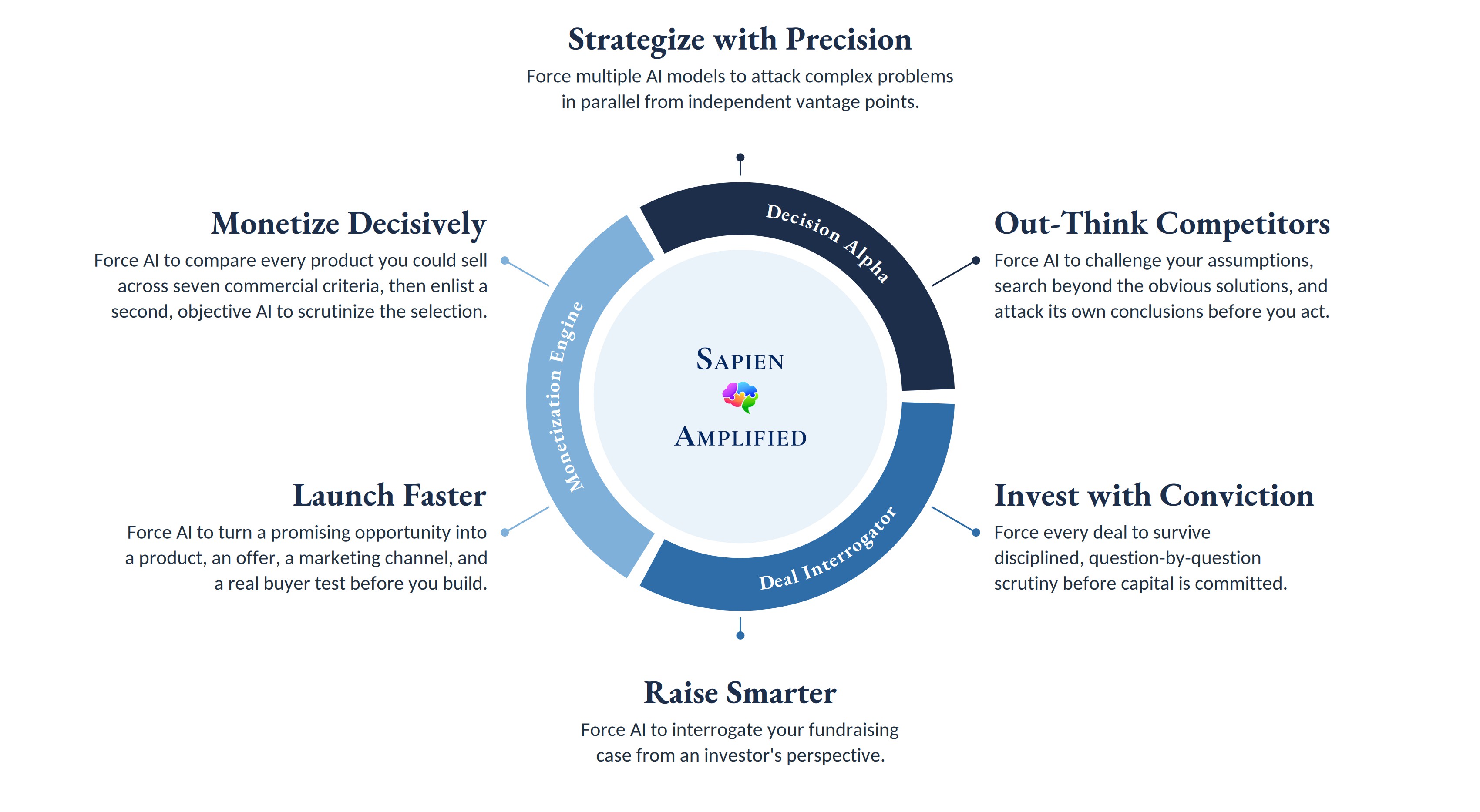
Strategize with Precision Force multiple AI models to attack complex problems in parallel from independent vantage points. Make stronger decisions before you commit money, time, or resources.
Invest with Conviction Force every deal to survive disciplined, question-by-question scrutiny before capital is committed. See exactly what the evidence supports, what it contradicts, and what still needs proof before you decide.
Launch Faster Force AI to turn a promising opportunity into a product, an offer, a marketing channel, and a real buyer test before you build. Eliminate weak directions early and move the best opportunity toward market with less wasted time and effort.
Out-Think Competitors Force AI to challenge your assumptions, search beyond the obvious solutions, and attack its own conclusions before you act. See more possibilities, expose more weaknesses, and reach better-supported decisions before committing to a direction.
Raise Smarter Force AI to interrogate your fundraising case from an investor's perspective. Identify where the pitch is vulnerable, what the evidence does not yet support, and what must be strengthened before serious investor conversations begin.
Monetize Decisively Force AI to compare every product or service you could sell across seven commercial criteria, enlist a second AI that did not make the selection to scrutinize the result, then orchestrate the launch of your choice. Know what to sell, what to offer those customers next, which channels reach them, and where to commit your resources.
Who Sapien Amplified Is For
Professionals whose work depends on sound judgment. People who must weigh incomplete information, challenge assumptions, and make recommendations others rely on. Sapien Amplified forces AI to deeply scrutinize reasoning, distinguish evidence from assumptions, and make uncertainty visible before you act.
Investors and allocators who see more opportunities than they can properly examine, where the cost of a wrong yes is measured in years. Sapien Amplified interrogates opportunities, pitch materials, financial models, and investment theses one point at a time, separates what the evidence supports from what the founder or seller asserts, and names what still needs proof before capital moves.
Dealmakers and acquisition professionals who must examine what a deal says, test the economics, evaluate strategic fit, and negotiate terms before making commitments. Sapien Amplified forces every point to survive question-by-question scrutiny, and marks what the deal has not proved.
Founders raising capital who will face investors attacking their numbers, market, and assumptions in a room where nothing can be revised. Sapien Amplified runs that attack first, from the investor's side, so the weak points surface while there is still time to fix them.
Entrepreneurs, business owners, and operators who make consequential decisions about pricing, expansion, profitability, partnerships, and where to focus next, without a team to pressure-test them. Sapien Amplified gives you the scrutiny a board would provide, before you commit.
Revenue, marketing, and growth leaders who must choose markets, shape offers, test pricing, and decide which channels and initiatives deserve more investment. Sapien Amplified widens the options before narrowing them, and forces the AI to argue against its own recommendation.
Executives and strategic leaders who set direction, evaluate competing priorities, and commit resources when the information is incomplete and the consequences matter. Sapien Amplified forces multiple models to work the decision independently and produces a written record you can test against what actually happened.
Consultants and advisors whose reputation rests on the reasoning they hand a client, where a plausible-sounding AI answer is a liability with their name on it. Sapien Amplified makes the AI show its evidence and mark every place where the analysis rests on assumption rather than fact.
Creators and knowledge entrepreneurs who must decide which expertise to commercialize, which products to develop, and how to turn an audience or specialized knowledge into revenue. Sapien Amplified compares every product you could build against the same criteria, has a second model scrutinize the pick, and puts a real buyer test in front of you before you spend months building.
Anyone facing expensive decisions they cannot undo. An acquisition, a market bet, a price change, a commitment of capital or reputation. Sapien Amplified is built for exactly those moments, and for any personal decision where being right matters, and the system is designed to say no when the evidence is weak.
What Do We Mean by “Forcing” AI?
We mean taking critical parts of the reasoning process out of the model's own judgment and replacing them with explicit rules the AI must follow. Sapien Amplified can force independent models to work in isolation before comparing conclusions, force the AI to separate evidence from assumption, force dissent against its own preferred answer, force uncertainty to remain visible, force escalation when the stakes rise, force a stop when outside proof is required, and force important decisions to leave a traceable record that can later be tested against results. Recusal, amnesia, quarantine, anchoring, calibration, convergence, divergence, sequencing, reversibility, provenance, falsifiability, and the other controls are different ways of constraining how AI is allowed to reason, challenge, communicate, and act. Force means the AI does not merely receive a better prompt. The AI operates under a more demanding set of conditions before you trust the output.
Is Sapien Amplified Just a Prompt Library?
No. A prompt library gives you instructions. Sapien Amplified controls every step of how a consequential decision is examined, from the first question to the final record. Triangulation sits at the center of the system: two or more AI models work the same decision independently, then are made to challenge each other, so agreement has to survive scrutiny instead of polite reinforcement. Around that core, different components act at different moments: the Reasoning Baseline sets the rules the AI must follow on every answer, specialized instruments challenge the question, widen the available paths, attack conclusions, audit entire conversations, and test finished work, and the records preserve what you decided so the reasoning can be compared with later results. The components have rules, roles, escalation paths, stop conditions, evidence boundaries, and explicit handoffs between them, and the system is built to say no when the evidence is weak. The prompts are how the system is delivered, and that delivery is a deliberate choice: you run the strongest model your account includes, your data does not pass through a separate third-party wrapper, you switch models the day a better one appears, and you can read every line of the Sapien Amplified protocol.
AI Decision Alpha
What AI Decision Alpha Enables You To Do
Make better decisions by altering how AI thinks and reasons.
AI Decision Alpha is a complete system for making consequential decisions with AI. It combines always-on reasoning rules, purpose-built decision instruments, independent model review, and outcome tracking into one coordinated process. The system strengthens human judgment rather than replacing it, so no single AI response, reasoning path, or unsupported assumption gets to carry an important decision by itself.
Instead of asking one AI model a critical series of questions and acting on the first plausible recommendation, you make AI test the foundation of the decision, surface materially different paths, attack its own reasoning, compare independent conclusions, and identify what still requires outside proof.
The Quality of Your Decisions Matters
Consequential decisions do not end when you make them. They become the acquisition you complete, the market you enter, the price you set, the product you fund, and the capital you can no longer deploy elsewhere. When one of those decisions is wrong, the loss is not limited to the immediate result. The wrong decision also consumes time, closes better alternatives, and leaves you making the next decision from a weaker position.
Outcomes Compound
Every consequential decision resets the starting point for the next one. The market you enter determines which customers and competitors you face. The price you set shapes demand, margins, and perception. The strategy you fund determines which opportunities remain available later. Stronger decisions preserve capital, create better information, and keep more options open; weaker decisions narrow those options and carry their costs forward. Improve decision quality even slightly across a series of choices, and those gains compound into more capital to deploy, better opportunities to pursue, and fewer months spent recovering from avoidable mistakes.
How AI Decision Alpha Works
Triangulates the Reasoning Power of Multiple AIs
Triangulation means examining the same consequential decision from multiple independent vantage points and comparing where those analyses agree, disagree, and why. In AI Decision Alpha, one AI rebuilds the decision through several distinct reasoning routes, while a second AI reaches its own conclusion before seeing the first model's analysis. The models then challenge each other directly, so agreement has to survive independent scrutiny rather than polite reinforcement. Where the analyses converge, the decision has held up across different routes. Where they diverge, you see the specific assumption, evidence gap, or tradeoff driving the disagreement. When the AIs cannot settle the remaining question, AI Decision Alpha identifies the outside evidence needed to resolve it. Use two comparably capable AI models at their strongest available reasoning settings. Each proposed revision needs a clear reason, so the models preserve sound reasoning rather than changing the work simply to agree.
Boosts AI Reasoning Capabilities
Raise the quality floor of every substantive AI analysis, automatically. Standing reasoning rules separate what your documents and numbers establish from what the AI assumes or infers, check important calculations, state what remains uncertain, identify the most likely way a recommendation could fail, and challenge questions that already contain the answer you want. AI also examines how your proposed plan could achieve your goal and what could prevent it from working. It considers what you could lose, whether you can undo the decision, and whether a smaller test would let you decide before fully committing. You can also tell AI to work independently, involve you in important decisions, or work through the decision with you. Set a deadline when needed; AI should prioritize the work, ask useful follow-up questions, and identify the specific help needed if progress is blocked. Better reasoning becomes the default rather than something you have to request.
Multiplies Your Potential Paths to a Solution
Force AI to search the real range of ways a problem could be solved before one familiar idea becomes the default. Materially different approaches have to make it onto the table, including directions outside your initial preference or framing. Variations that are essentially the same idea get collapsed together, leaving genuinely different paths rather than a long list of cosmetic alternatives. You narrow only after you have seen more of what is actually possible.
Attacks Every Idea, Argument, and Analysis Before You Commit to One
Put what you are about to trust under pressure before money, time, capital, or reputation gets committed to it. AI Decision Alpha interrogates the question beneath an analysis, attacks the AI's own reasoning, takes apart a persuasive argument, recommendation, proposal, or rebuttal someone else puts in front of you, and tests a document, plan, prompt, or product the way a first-time user will encounter it. Each attack separates what survives scrutiny from what fails, what was never established, and what still needs to be repaired or proved before you act. AI looks for important risks, information, or alternatives missing from the supplied analysis. It explains why each omission matters and what you can do to investigate it.
Identifies Exactly Where and How the Reasoning in a Conversation Went Astray
Catch failures that develop across an entire AI conversation rather than inside one isolated response. AI Decision Alpha retraces the exchange from the beginning and identifies where the original objective changed, an early assumption became accepted as fact, you and the AI stopped challenging each other, momentum preserved a weak direction, or an important warning was dismissed. Instead of discovering only that the final conclusion is weak, you see the earliest message where the reasoning materially failed and which later conclusions were built on top of that failure.
Records Every Decision and Turns Results Into Better Judgment
Preserve what you actually believed before hindsight changes the story, then turn the eventual outcome into better information for the next decision. Record what you chose, the serious alternatives you rejected, the reasons that carried the decision, what remained uncertain, what would cause you to reverse course, and what you expected to happen. When the result becomes visible, compare the original reasoning with the result and identify what held up, what failed, and what was missed. The review considers how you carried out the plan, circumstances that changed, and luck before concluding what your reasoning got right or wrong. Over time, each consequential decision becomes evidence that can improve the quality of the next one.
Optimizes How Your AI Communicates with You
Make AI communicate consequential analysis in language you can understand on the first read. AI Decision Alpha removes vague references, unexplained abstractions, compressed shorthand, and sentences that force you to figure out what "it," "this," "the result," or "the recommendation" actually refers to. The AI names the specific deal, strategy, price, number, assumption, or action being discussed, defines important terms when they first appear, and states conclusions in complete plain English. You spend less time decoding AI output and more time using the analysis.
What AI Decision Alpha Enables You to Do
Out-think competitors who use AI the old way
You act on a decision that has survived more scrutiny than a single AI response ever gets, while your competitors act on the first plausible answer.
Out-think competitors who ask one AI what to do and act on the first plausible response.
Put the same consequential decision through independent reasoning routes, different AI models, adversarial review, and outside evidence when outside evidence can settle the question better than another AI response.
Use the strongest AI available without handing your decisions, deals, or business information to another software platform.
AI Decision Alpha runs inside the ChatGPT, Claude, or other AI account you already use, so you choose the model and reasoning setting, switch models whenever a stronger model appears, and read every line of the Sapien Amplified protocol.
Strengthen every consequential decision through triangulation
You see where independent routes agree, where the routes disagree, and which shared assumption could make every route wrong at once.
Rebuild one consequential decision through up to three genuinely different reasoning routes inside a single AI and see whether independent reasoning reaches the same place.
Single-Model Decision Triangulation makes the model approach the same investment, product, strategy, or pricing decision through genuinely different reasoning routes and exposes where apparent agreement depends on one shared assumption.
Put the same open decision in front of two different AI models BEFORE either model sees the other's conclusion.
Cross-Model Decision Triangulation can make both models independently analyze the same acquisition, investment, product, or strategy first, preventing the second model from merely editing or reacting to the first model's reasoning.
Make two AI models find where the other model is wrong instead of politely agreeing.
Cross-Model Decision Triangulation requires substantive disagreements to stay open until the models agree, one model withdraws the objection, you make a decision that belongs to you, or outside evidence settles the factual dispute.
Know when AI review is finished and when another AI response would add more noise instead of more knowledge.
Cross-model review stops after a defined number of rounds, requires both models to confirm the same unchanged work before agreement is complete, and identifies the document, calculation, customer, expert, test, or other outside evidence needed when AI cannot settle the remaining question.
See more of your options BEFORE you narrow them
You choose from materially different directions instead of the first three that came to mind.
Surface a full spectrum of materially different ways to solve a critical problem BEFORE you narrow the field.
Solution Spectrum pushes the AI beyond the familiar product, strategy, pricing, market, or operating approach and forces genuinely different solutions onto the table before evaluation begins.
Stop getting ten versions of the same idea disguised as ten different options.
Solution Spectrum requires each proposed solution to differ on meaningful dimensions and merges solutions that occupy the same position, so you see genuinely different directions rather than variations in wording.
Attack every part of the decision BEFORE you commit
You commit money, people, time, or reputation only after each surface of the decision has been attacked.
Interrogate the foundation of an important decision BEFORE the analysis begins.
The Foundation Audit exposes hidden assumptions, loaded wording, missing context, false choices, unsupported causes or motives, and a problem framed too narrowly or in the wrong direction before the AI builds an analysis on top of those flaws.
Make AI attack the analysis you are most tempted to trust BEFORE you act on the analysis.
The AI Reasoning Audit reconstructs the case from the underlying evidence, searches for evidence that could overturn the conclusion, builds the strongest opposing case, and tells you what survived, what weakened, what failed, and what the first analysis missed.
Tear apart someone else's persuasive email, memo, proposal, defense, recommendation, or rebuttal BEFORE you accept what the person wants you to believe or do.
Argument Interrogation restates the person's argument fairly before testing it, separates evidence from interpretation, checks the numbers, exposes unstated assumptions, and identifies where the conclusion goes further than the supplied facts.
Get the strongest counterargument, the decisive proof still missing, and the exact questions to send back.
Argument Interrogation identifies logical failures, bias, unanswered questions, and persuasion that adds no evidence, then produces the strongest case against the argument and the specific documents, numbers, sources, or answers needed to settle what remains unresolved.
Test anything AI helped you build the way a first-time user will encounter the finished work BEFORE you send, publish, launch, or use the finished work.
The AI Artifact Audit walks through a document, prompt, plan, product, or instruction set without relying on the author's intentions and finds contradictions, missing steps, broken workflows, unsupported promises, and places where a new user gets stuck.
Audit an entire consequential AI conversation from the first message to the last BEFORE relying on the conclusion the conversation produced.
The Full Conversation Audit finds where the original objective changed, where an early guess later became accepted as fact, where you and the AI stopped challenging each other, where a warning was dismissed, and the earliest message where the reasoning needs to be corrected.
Know exactly what your AI actually knows BEFORE you trust the decision
You read every important analysis once and know how much weight the analysis can carry.
Make every consequential AI analysis show you what comes from facts, what comes from assumptions, and what comes from inference.
The Reasoning Baseline forces the AI to separate what your documents, numbers, and sources establish from what the AI is filling in, so an assumption cannot quietly acquire the authority of a fact.
Know what could make an AI-supported decision wrong BEFORE you commit money, people, time, or reputation.
Every substantive analysis identifies the most likely way the conclusion could fail, states what remains uncertain, checks important numbers, and uses numerical confidence only when the available evidence can support the number.
Read consequential AI analyses once, without deciphering what it, this, the result, or the recommendation refers to.
The Reasoning Baseline requires the AI to name the actual deal, product, price, strategy, number, or decision being discussed and to state complete points instead of compressed AI shorthand.
Compound sound judgment with every decision you make
Each decision becomes better information for the next one.
Record what you decided and why BEFORE the outcome can rewrite your memory of the decision.
The Decision Record preserves the actual choice, the serious alternatives considered, the reasons that carried the decision, what remained uncertain, what would cause you to reverse course, the result you expect, and when the decision should be reviewed.
Turn past AI-assisted decisions into evidence about where your reasoning was right, wrong, or incomplete, and make future decisions easier to evaluate.
Decision Optimizer scrutinizes past decisions against the results that followed, and for new decisions records what you expect before you act so the later result can be compared with the prediction you actually made.
Components of AI Decision Alpha
| Document | When You Use the Document | What the Document Does |
|---|---|---|
| Start Here (short guide) | First. Read once. | Tells you what you own, what each instrument catches, which instrument fits the situation you are in, and the order the instruments run in. |
| The Reasoning Baseline (document with one prompt, installed once) | Installed once. Runs on every substantive answer. | Makes every answer separate what is known from what is guessed, state uncertainty plainly, check important numbers, and challenge a loaded question. Bans the two habits that force you to decode an answer: references with no clear subject, and sentences that need interpreting. |
| Foundation Audit (document with prompt) | Before an important analysis begins. | Examines how you described the decision you face, identifies assumptions you have not established and options your wording excludes, and rewrites your request before the AI answers it. |
| Solution Spectrum (document with prompt) | Before a critical creative or strategic choice is narrowed. | Makes the AI produce materially different ways to solve the problem, including the ones the AI would normally leave out. |
| AI Reasoning Audit (document with prompt) | After an analysis exists and before you act on the analysis. | Makes the AI attack the AI's own assumptions, inferences, and conclusions. |
| AI Artifact Audit (document with prompt) | Before anything you built with AI is sent, published, or used. | Makes the AI test the built thing the way a first-time user would. |
| Argument Interrogation (document with prompt) | When someone's email, memo, proposal, or rebuttal asks for your agreement or your action. | Tears the argument apart: where the argument is weak, which fallacies and biases are doing the work, and the strongest counterargument. |
| Single-Model Decision Triangulation (document with prompt) | When a conclusion matters enough to be rebuilt. | Makes the AI start over by up to three genuinely different reasoning routes and report where the routes agree, conflict, or stay unresolved. |
| Cross-Model Decision Triangulation (document with prompts) | When two AI models review the same important work. | The rules for the exchange: fixed roles, version control, a blind mode where both models answer first, disagreement rules, a three-round cap, a final record, and the three ways to carry the message between the models. |
| Cross-Model Decision Triangulation Code (folder of code files) | When you want the two models to exchange work automatically. | A folder for technical users that runs the rounds through the models' APIs, archives every round, and stops at the limit. |
| Full Conversation Audit (document with prompt) | At the end of a long consequential conversation, or midstream at a major decision point. | Makes the AI reread the whole conversation and find where the goal changed, where a guess became a fact, and the earliest message to correct from. |
| Decision Optimizer (document with procedure) | After the outcome can be observed, or before you act on a conclusion. | Compares the decision with what actually happened and records what the system caught, what the system missed, and which warnings were false alarms. |
| The Decision Record (one-page template) | Immediately before a consequential action. | One page: the decision, the alternatives, the reasons, the uncertainty, what would reverse the decision, the result you expect, when to review, and the later outcome. |
| The Prompt Library (one file, nine complete prompt blocks) | Whenever you need a prompt without opening the full document. | Every prompt in one file, each with the instrument name, the ability line, and when to use the prompt, copied one at a time. |
| Quick Starts (nine short documents covering the Baseline and eight instrument prompts, with the same complete prompts) | Once you have read a full document and only need to run the instrument. | Each Quick Start: what the instrument does, when to use the instrument, how to run the instrument, and the prompt. |
From the Creator
I run two frontier models against each other on everything important: strategy, product decisions, capital allocation. In my own use, when I review the work afterward, the triangulated output is almost always higher quality than what I get from any single model. This system is the set of rules that makes that gap reliable instead of accidental.
Brian Ortiz, founder of Falcon Scaling and Polarity IQ
The 30 Second AI Decision Alpha Value Proposition
AI can produce a polished recommendation about an investment, product, price, or strategy in seconds. AI Decision Alpha is the system you use before that recommendation moves capital, consumes months of work, or closes off better options. It triangulates the decision through independent reasoning routes and multiple AI models, then adds the controls a single AI response lacks: it challenges the question, broadens the possible paths, attacks the reasoning you are most tempted to trust, and identifies what still requires outside proof. It records what you believed before hindsight changes the story and compares the reasoning with the eventual result. The value is not more AI output. It is stronger judgment, fewer avoidable mistakes, less time lost to weak directions, and better evidence for every consequential decision that follows.
What You Get With AI Decision Alpha
The download holds the fifteen items listed in the Components table above: one short guide, the Reasoning Baseline prompt you install once, nine instruments, eight of which come as a document with the prompt inside and one of which, the Decision Optimizer, is a written procedure, a folder of code for the automated two-model exchange, the Decision Record template with a field for the result you expect, the Prompt Library file holding nine complete prompt blocks, and nine Quick Starts covering the Baseline and eight instrument prompts, with shorter run steps and the same complete prompts. Those items are the system. What follows is what the AI produces for you when you run the system on your own decision. Which of these you receive depends on which instruments you run; most decisions need two or three, not all nine.
- Proof that you are asking AI the right question: before AI recommends what you should do, the Foundation Audit examines how you described the decision, identifies assumptions you have not established and options your wording excludes, and rewrites your request so AI considers those issues.
- A list of materially different courses of action for the decision you need to make, produced by Solution Spectrum, with any two that differ only in wording merged into one.
- A report from the AI Reasoning Audit on which parts of an AI analysis survived attack, which parts weakened, which parts failed, and what the analysis missed.
- A list from the AI Artifact Audit of the contradictions, missing steps, and unsupported promises in a document, plan, prompt, or product you built with AI.
- The strongest counterargument to someone else's memo, proposal, or rebuttal, any decisive proof the person has not supplied, and the exact questions to send back, or a finding that the argument holds, from Argument Interrogation.
- A comparison from the two triangulation instruments showing where separate reasoning routes, or two AI models, agree and disagree on your decision, and, for each disagreement, whether outside evidence can settle the point or the call is yours.
- A report from the Full Conversation Audit naming any material reasoning failure in a long AI conversation, where the failure began, and which later conclusions depend on that failure, or confirming that the reasoning held.
- Your completed Decision Record for the decision, including the result you expect, and later, from the Decision Optimizer, a comparison of that record with what actually happened.
AI Deal Interrogator
What AI Deal Interrogator Enables You To Do
Interrogate any deal one decisive question at a time, whether you are the one investing or the one raising, BEFORE capital or credibility is committed.
AI Deal Interrogator is a rigorous system designed to scrutinize investment opportunities and challenge fundraising pitches before investors do. It combines detailed questioning, separate AI examinations, and repeated testing as evidence or terms change to identify what you need to investigate, correct, or substantiate. You run the system in your own AI account. No separate software platform or AI Decision Alpha purchase is required.
If you are evaluating an investment, Deal Interrogator challenges the assumptions behind the opportunity, examines the proposed price and terms, and compares the financial requirements with your objectives and limits. It identifies obligations beyond your initial investment, questions unsupported projections, and specifies the evidence you still need from the company, seller, borrower, or fund manager.
If you are raising capital, Deal Interrogator challenges your projections, valuation, proposed terms, and supporting evidence before investors question them. It identifies weaknesses in your pitch, develops questions the type of investor you are approaching commonly asks, and specifies what you need to correct or substantiate. When your evidence supports less than your pitch promises, AI proposes revised wording you can defend.
The examination begins with the deal documents, financial figures, and objectives you provide. AI identifies the assumptions, risks, and terms that need the most scrutiny, then asks you questions about them one at a time. If your response does not substantiate a projection or assertion, AI asks for the figures, documents, or explanation needed to assess it. Missing evidence remains recorded as missing. Each important part of the deal is assessed separately, so a favorable total score cannot conceal a decisive weakness.
Deal Interrogator allows you to run separate examinations on two AI models, then compare their findings to expose disagreements and omissions that one review could miss. When you receive new documents, revise your pitch, or negotiate different terms, you can re-examine the affected findings. AI tests whether those changes resolve the original concerns and identifies any new problems they introduce.
You receive a written Deal Sheet containing the financial calculations, supporting and conflicting evidence, unresolved questions, and prioritized requests for missing information. Investors also receive an assessment of financial exposure and conflicts with their stated limits. Capital raisers receive specific pitch corrections, revised wording for unsupported assertions, and questions to prepare for before investor discussions. The Deal Sheet supports your examination of the opportunity; it does not authenticate supplied documents or make an investment decision for you.
Questions and Financial Checks Tailored to Your Deal
AI Deal Interrogator examines startup investments, acquisitions and buyouts, fund commitments, private credit, and real assets. The questions and calculations change with the transaction. A startup review can examine how long available cash will fund projected spending and how future funding could reduce your ownership. An acquisition review can examine whether the business generates enough cash to cover loan payments after necessary operating expenses. If your deal combines investment types or has unusual terms, AI identifies the additional questions and calculations needed and asks you to confirm what will be examined.
| For Investors | For Founders and Other Capital Raisers |
|---|---|
| Attack the investment before your capital does. Find out what the supplied information supports, what it contradicts, and what still has no answer. Identify the documents the seller, borrower, fund manager, or company still has to produce, and who probably holds each one. Separate whether the business is strong from whether this amount at this price and on these terms reaches the result you wrote down. Write your walk-away rules before attachment to the deal deepens, and see plainly when the record breaches one. Keep a dated Deal Sheet, and record your own decision beside it. | Attack the pitch before investors do. Expose the questions most likely to damage the pitch in the room. Find where the pitch says more than the numbers, documents, or customer information can support. Keep the strongest version of the pitch the evidence can honestly defend. Identify the exact repairs and proof required before serious investor meetings. Retest after the repairs are made, reopening every point the new information touches instead of repeating the entire interrogation. |
Why Deal Analysis Needs a Specialized Interrogator
The Interrogator supplies deal-specific mechanics: financial checks matched to the transaction type, scrutiny of decisive points, one-question-at-a-time examination, no summed score, a stop rule for outside proof, source-linked findings, and a structured Deal Sheet. Investors supply objectives and walk-away rules. Capital raisers supply the fundraising case and the stage and type of investor they are approaching.
| Typical AI Deal Review | AI Deal Interrogator |
|---|---|
| Summarizes every page of the materials | Identifies the few parts of the deal that can change what you do next |
| Produces a list of gentle questions | Questions one decisive issue at a time and does not accept a vague answer as proof |
| Reduces the deal to a total score | Reports every important part separately so a strength cannot average away a deal-ending weakness |
| Notes that more information is needed | Writes the exact document, number, customer, contract, or source needed and explains why the proof matters |
| Ends with more analysis | Forces the conversation to end in a Deal Sheet you can use |
How AI Deal Interrogator Works
Checks Whether the Deal's Elements Contradict Each Other
Before asking the first question, AI Deal Interrogator checks the arithmetic the deal type depends on. For a startup investment: the stated growth rate against the revenue figures, the runway against cash and burn, and the ownership you expect against the outcome you need, with dilution and later funding taken into account. For an acquisition: the sustainable cash left after replacement management and necessary spending against the debt payments. For private credit: repayment capacity, seniority, and collateral against the loan. For a fund commitment: distributions after fees and carried interest against the capital calls. For real assets: operating cash flow after necessary spending against the financing and the sale assumptions. Every figure is marked before tax or after tax. When the figures do not reconcile, the Interrogator identifies the exact conflict and asks for the explanation, calculation, or document needed before the questioning continues.
Concentrates Scrutiny on What Could Undermine the Investment or Fundraising Case
AI Deal Interrogator identifies the points that matter most if they turn out to be wrong. For investors, these are the assumptions, risks, and terms that could affect financial exposure or conflict with the objectives and limits you supplied. For capital raisers, these are weaknesses in the economics or supporting evidence that could undermine the fundraising case. You confirm the list before questioning begins, and the interrogation prioritizes the points most likely to change the findings.
Examines One Issue at a Time and Records What Remains Unanswered
AI Deal Interrogator questions one unresolved point at a time, beginning with the point most likely to change the picture. A confident answer does not close a point merely because the answer sounds plausible. Each answer leaves the point in one of five states: the supplied information supports it, a narrower version is supported, the information contradicts it, an identifiable document could settle it, or nothing obtainable can settle it now. A point that would end the deal if wrong never passes on reassurance or analogy. Every point stands on its own, so a strong number cannot average away a deal-ending weakness, and no total score is ever computed.
Adapts the Examination to Your Role and Deal Type
For investors: supply the result you want from the money, the holding period, the loss you could accept, and limits on concentration, leverage, or guarantees, plus fund size and expected ownership where relevant. The examination connects the proposed amount and terms to those objectives. For capital raisers: supply your fundraising case and the stage and type of investor you are approaching. The examination tests the supporting economics and evidence and considers the questions that investor type commonly emphasizes. Both roles can supply their own categories or checklist; otherwise, the system uses the built-in coverage for the deal type.
Narrows Every Overstated Point to the Version Your Documents Support, and Names the Source
Every important point about the business, the numbers, the customers, the market, the competition, the price, and the terms is tested against the supplied information. When the materials say more than the information supports, AI Deal Interrogator preserves the narrower version the facts can defend. When the information does not settle a point, the point stays open rather than gaining credibility through repetition, confidence, presentation quality, or another round of AI discussion. Every finding names the source it rests on, with its date and the relevant passage, and marks the details that are missing.
Stops Arguing and Writes the Document Request, Naming Who Probably Holds It
AI Deal Interrogator stops debating when the answer depends on information that does not exist inside the conversation. Where an identifiable document, number, customer confirmation, contract, or qualified outside review could settle the point, the Deal Sheet records exactly what is needed, who probably holds it, and why obtaining it could change the picture, with the requests ordered by how much each one could change. Where nothing obtainable can settle the point now, the sheet says so and keeps the uncertainty in view rather than pretending a document would resolve it. Reading a supplied document does not authenticate it, and the sheet lists the accounting, legal, tax, or technical checks that still belong with a specialist.
Ends Every Full Interrogation in a Dated Deal Sheet You Keep and Can Update
Every full interrogation closes with a dated Deal Sheet, produced when you paste the second prompt into the same conversation. Both roles receive the transaction details, sources, relevant calculations, findings for each decisive point, prioritized evidence requests, the strongest case for and against, and what could change the findings. The additional written findings for each role are explained below.
For investors: You receive a written assessment showing which parts of the investment the supplied evidence supports, which it contradicts, what remains unverified, and where the proposed terms conflict with your stated limits. You make the investment decision and can record it beside the findings.
For capital raisers: You receive a written Deal Sheet identifying weaknesses in your fundraising case, the evidence you need to provide, specific changes to make, and revised wording for points your existing evidence does not fully support. It also identifies questions the type of investor you are approaching commonly asks, so you can prepare your answers before the meeting.
Screens a Deal in Ten Minutes and Names the Fastest Check Worth Running
The Ten Minute Screen identifies up to three points most likely to end the deal if wrong, checks what the current materials establish about each, and names the fastest useful check. Deals and pitches that survive the screen can move into the full question-by-question interrogation. Deals and pitches that show a decisive problem at the screen do not consume hours of attention. The screen never produces a Deal Sheet, and the ten minutes describe a short first look rather than a guaranteed finishing time.
Retests After Repairs or New Information Without Repeating the Whole Interrogation
Both investors and capital raisers use Repair and Retest. Investors return with new diligence documents or revised pricing, financing, or contractual terms. Capital raisers return with repaired projections, revised pitch wording, or additional supporting evidence. The prompt takes the prior Deal Sheet and new information, reopens every affected point, including points that previously held, carries unchanged findings forward with their original dates, and produces an updated sheet with a change log. A change to the basic transaction requires a fresh full interrogation.
Compares Two Independent AI Reviews and Records Where They Disagree
Run the interrogation on two different AI models without letting either one see the other's work, then paste both Deal Sheets and the original sources into the Compare Independent Reviews prompt. The comparison separates differences caused by different inputs from real disagreement, corrects arithmetic or reasoning only where the sources justify the correction, names the omissions both reviews share, and records every unresolved disagreement with the information that would settle it. Agreement between two models does not verify the documents, and the comparison never substitutes a vote for missing information.
What AI Deal Interrogator Enables You to Do
For Both Investors and Capital Raisers
Apply the same evidence discipline to evaluating an investment or preparing a fundraising case. Examine the decisive points, identify missing proof, compare AI reviews, and retest when the information changes.
Concentrate the examination on what could undermine the investment or fundraising case.
For investors, the AI prioritizes points that could affect your financial exposure or conflict with your objectives. For capital raisers, it prioritizes weaknesses that could undermine the case presented to investors. Both roles confirm the list before questioning begins.
Find out before the first question whether the numbers in the deal materials agree with each other.
The AI checks the arithmetic your deal type depends on: growth against revenue, runway against cash and burn, operating cash against debt payments, proposed ownership against projected outcomes, or distributions after fees against capital calls. Investors see financial inconsistencies to investigate; capital raisers see figures to reconcile before presenting their case. Each figure is marked before tax or after tax.
Judge the deal on the categories you already use, whether you use four or sixty.
You paste your own framework, from four items to a full checklist, and the AI maps the deal under your categories, questions you under your categories, and writes the Deal Sheet in your categories. If you supply no framework, the AI uses the built-in coverage for your deal type: startup investment, acquisition or buyout, fund commitment, private credit, or real assets.
Challenge the Evidence and Reasoning
Examine each important point separately so a strength in one area cannot conceal a decisive weakness in the investment or fundraising case.
See the strongest case against the deal and the strongest case for the deal, side by side.
The AI builds both cases from what the interrogation established, and the case against may use the facts that made a point fail, so you can weigh the two before deciding anything.
Challenge your own biases and identify potential blind spots before they influence how you judge a deal.
The AI tests whether your enthusiasm, skepticism, prior experience, relationship with the founder or seller, attachment to a thesis, money already spent, or preference for a particular outcome is causing you to give parts of the deal more weight than the facts justify.
See exactly which parts of the pitch are supported, which need to be narrowed, which break under scrutiny, which still need outside proof, and which nobody can settle right now.
Every important point about the business, the numbers, the customers, the market, the team, the competition, the price, and the terms gets tested before the interrogation moves on.
Keep a decisive weakness visible even when other parts of the deal are strong.
The Deal Sheet reports each important part of the deal on its own and never adds the parts into a total, because a summed score lets a strong category hide a fatal one.
Stop arguing when only outside proof can settle the point
Investors see which evidence to request. Capital raisers see which evidence to prepare. Both receive specific requests ordered by their importance to the findings.
Stop wasting time arguing about something that can only be settled by a document, number, customer, contract, or outside source.
When the AI reaches something the conversation cannot settle, the AI tells you exactly what information is missing and why obtaining it could change what the record shows. When nothing obtainable can settle the point, the Deal Sheet says so instead of pretending a document would.
Know exactly which parts of a deal AI cannot verify from the deal materials, numbers, and answers you supplied.
The AI tells you when revenue, customer figures, contracts, market statistics, or other important information still needs to be checked outside the conversation, and lists the accounting, legal, tax, or technical questions that belong with a specialist. Reading a supplied document does not authenticate it.
Leave with a Deal Sheet you keep
The conversation cannot end as talk. Every full interrogation ends in a dated written record you keep, can update, and can judge against the outcome later.
Leave every full interrogation with one dated Deal Sheet showing what was tested, what held up, what failed, what still needs proof, and what would change the findings.
Both roles keep a written record of sources, findings, calculations, and open questions. Investors receive an assessment of the evidence and conflicts with their stated limits. Capital raisers receive specific corrections to their fundraising materials and requests for missing proof.
Know immediately when the Deal Sheet is incomplete because important parts of a deal were never examined.
If the interrogation stops early, the Deal Sheet says PRELIMINARY DEAL SHEET and identifies exactly what remains untested.
Compare what the Deal Sheet found before a deal was decided with what actually happened afterward.
When the company later succeeds, struggles, raises, fails to raise, or produces new information, you can see what the interrogation caught, what the interrogation missed, and what you should examine differently in the next deal.
Put two AI models on the same deal and see exactly where they disagree.
Run the interrogation on a second AI model without showing it the first result. The Compare Independent Reviews prompt then matches the two Deal Sheets point by point, separates input differences from real disagreement, corrects only what the original sources justify, and records every unresolved disagreement with the information that would settle it. Agreement between two models does not verify the documents.
Retest after new evidence, revised terms, or fundraising repairs.
Investors supply new diligence documents or revised terms; capital raisers supply repaired materials or additional proof. With the prior Deal Sheet, the AI reopens every affected point, including points that previously held, carries unchanged findings forward with their dates, and issues a new sheet with a change log.
Screen fast and run everything in your own AI account
Use a short first look to identify potentially decisive problems in an investment or fundraising case. Both roles run the process in their own AI account.
Screen a deal in about ten minutes before deciding whether the deal deserves a full interrogation.
The Ten Minute Screen identifies up to three points most likely to end the deal if wrong, checks what the current materials establish about each one, and names the fastest useful check. The screen never produces a Deal Sheet.
Run the entire interrogation inside the ChatGPT, Claude, or other AI account you already use.
You paste the prompts into your existing AI, provide the deal or pitch materials, answer the interrogation, and save the Deal Sheet when the conversation ends. No additional software platform is required.
For Investors
Examine the proposed investment against your objectives and limits. See your financial exposure, identify outstanding diligence, and make your own investment decision from the recorded findings.
Know before the first question which parts of the deal must hold for this money to reach the result you want.
You state the result you want from this money, the holding period, the loss you could accept, and, where they apply, the fund size and the ownership you expect at exit. The AI works out what the deal must reach, whether that is an exit value, a coverage ratio on the debt payments, or distributions after fees, and treats the parts of the deal that outcome depends on as the parts that would end the deal if wrong.
Write down the conditions that would make you walk away from an investment before you become more attached to the deal.
You can lock in specific limits around valuation, customer concentration, margins, ownership, coverage, regulatory exposure, or any other issue that should stop the investment. When the record breaches one of those rules, the Deal Sheet says YOUR RULE BREACHED and shows your rule next to the fact that broke it.
Separate whether a company looks strong from whether this amount at this price and on these terms reaches the result you wrote down.
The AI separately examines business quality and the proposed investment terms, helping you identify where enthusiasm for the company is influencing your assessment.
See what you would be committing before you commit it.
The AI classifies the action as easily reversible, partly reversible, or difficult to reverse, and lists the money at risk, the time committed, the illiquidity, any guarantees, any future funding obligations, and the concentration you would be taking on.
Get a ready-to-send list of the exact information you still need from the seller, borrower, fund manager, or company before you invest more time or capital.
The Deal Sheet specifies the missing financial schedule, customer contract, retention number, cap table, margin breakdown, reference call, or other proof you need, names the likely holder, and ranks each item by how much it could change the picture.
Read the investor result and record your own decision.
You receive a written assessment showing which parts of the investment the supplied evidence supports, which it contradicts, what remains unverified, and where the proposed terms conflict with your stated limits. You make the investment decision and can record it beside the findings.
For Founders and Other Capital Raisers
Examine your fundraising case from the perspective of the investor type you are approaching. Identify unsupported points, prepare missing proof, and address specific repairs before investor discussions.
Rehearse the questions the type of investor you are pitching commonly emphasizes.
You name the stage and type of investor, for example a seed fund, a large multi-stage fund, a family office, or an angel. The AI gives priority to the questions that investor type commonly emphasizes, while the confirmed list of what the deal depends on sets the actual order, because investors of the same type do not all share the same priorities.
Keep the strongest version of your pitch that the facts can actually support.
If your original wording is too strong, the AI rewrites the point into the narrower version your numbers, documents, customer information, or other proof can defend.
Get a written list of changes and supporting evidence needed before presenting your fundraising case.
The Deal Sheet lists the weaknesses in your fundraising materials, the specific changes needed to address them, and the supporting documents you still need to provide. You can use that written list to revise your materials and prepare your answers before investor discussions.
Expose the questions most likely to damage your fundraising pitch before an investor asks them in the meeting.
The AI finds where your pitch says more than your numbers or documents can support and tells you what to repair before your credibility is on the line.
Components of AI Deal Interrogator
| Component | When You Use the Component | What the Component Does |
|---|---|---|
| Quick Start (entry guide) | First, when you want to run one review now. | The steps in order, from the first prompt to the saved Deal Sheet. |
| AI Deal Interrogator guide (entry guide) | First, when you want the whole process explained. | How to prepare the materials, write down the result you want, run the questioning, read the Deal Sheet, retest, and compare two reviews. |
| Interrogate the Deal (prompt) | Whenever you evaluate a deal or prepare a pitch. Its fields take your role, deal type, materials, the proposed transaction, the result you want or the investor you are pitching, your framework, and your walk-away rules. | Checks the financial calculations relevant to your deal type, identifies the assumptions and terms that matter most, asks you to confirm that list, and examines one issue at a time. Records the supporting or conflicting evidence, any narrower conclusion it supports, and the questions that remain unresolved. |
| Produce the Deal Sheet (prompt) | In the same conversation, after the questioning. | Produces a written Deal Sheet containing the calculations, financial exposure, findings, prioritized requests for missing evidence, and strongest arguments for and against the deal. It explains which new documents, corrected figures, or revised terms would require the findings to be reconsidered. Capital raisers also receive specific changes to make and revised wording for unsupported parts of their pitch. |
| Ten Minute Screen (prompt) | Before a deal has earned a full interrogation. | Finds up to three points most likely to end the deal if wrong and names the fastest useful check. Never produces a Deal Sheet. |
| Repair and Retest (prompt) | After new documents, completed repairs, or changed terms. | Reopens every point the change touches, carries unchanged points forward with their dates, and issues a new version of the sheet with a change log. |
| Compare Independent Reviews (prompt) | After two full reviews on two AI models. | Matches the two Deal Sheets point by point, separates input differences from real disagreement, and records what would settle each one. |
| Worked Example (reference) | Before your first run, to see the output. | A complete review of an invented acquisition, from the first question through the Deal Sheet, a retest, and a comparison. |
| Deal Sheet Template (reference) | When you want to see every field before running a review. | Every section and field the Deal Sheet contains, blank. |
| Value Proposition (reference) | When you want the product explained in one document. | What the system does for you, how the examination works, and what it does not establish. |
What AI Deal Interrogator Does Not Do
AI Deal Interrogator does not verify facts outside the materials and answers you provide, does not authenticate a document by reading it, and never tells you to invest or to walk away. For an investor, the result describes what the supplied information supports, contradicts, or leaves open, and you make the investment decision. For a capital raiser, the result addresses whether the case is ready for serious investor scrutiny. Missing proof remains missing until the proof is obtained, and a question nobody can settle now stays on the sheet as open. Honest inputs are required because a rigorous interrogation of false or incomplete inputs remains built on false or incomplete inputs.
The purpose is not to make a weak deal strong or a strong deal safe. The purpose is to make every important part of the deal earn the next action before capital or credibility is committed.
The 30 Second AI Deal Interrogator Value Proposition
AI Deal Interrogator is a repeatable system for examining any deal, whether you are the one investing or the one raising. Each interrogation goes deep on the specific opportunity or pitch in front of you: the Interrogator checks the numbers for the kind of deal it is, identifies the points that decide whether the deal reaches the result you wrote down, questions those points one at a time, exposes what the supplied information cannot support, and turns every open point into a request for proof, a pitch repair, or a plainly stated uncertainty. Investors leave each interrogation with a dated Deal Sheet showing what the record supports, what it contradicts, and what is still owed, and make the investment decision themselves. Founders and other capital raisers leave with a sharper pitch, a specific repair plan, and the strongest version of the story the facts can defend. The same system is ready for the next deal, retests when the facts change, and compares two independent AI reviews.
A summary tells you what the deal says. AI Deal Interrogator tells you what the deal can prove.
What You Get With AI Deal Interrogator
The download holds ten Word documents in three folders. Start Here holds the Quick Start and the full guide. Run The System holds the five prompts: Interrogate the Deal, Produce the Deal Sheet, Ten Minute Screen, Repair and Retest, and Compare Independent Reviews. Key Reference Files holds the Worked Example, the Deal Sheet Template, and the Value Proposition. Those documents are the system. What follows is what the AI produces for you when you run the system on a deal or a pitch. Which of these you receive depends on which prompts you run and on whether your role is investor or capital raiser.
For Both Investors and Capital Raisers
- A check, before the first question, of whether the figures your deal type depends on agree with each other, naming any conflict and the document or calculation that resolves it, with each figure marked before tax or after tax.
- A confirmed list of decisive points, organized under your own categories or the built-in deal coverage. Investors examine the points affecting exposure and their objectives; capital raisers examine the points supporting or undermining the fundraising case.
- For each important point, a written explanation of the supporting or conflicting evidence, any narrower conclusion that evidence supports, and what remains unresolved. Where possible, it identifies the additional evidence needed to answer the question.
- A dated Deal Sheet recording the transaction, your role, sources, relevant calculations, each point and its finding, prioritized evidence requests, the strongest case for and against, and what would change the findings. The sheet is marked PRELIMINARY when decisive points remain unexamined. The role-specific results are explained below.
- From the Ten Minute Screen: up to three points most likely to end the deal if wrong, what the materials establish about each, and the fastest useful check.
- From Repair and Retest: a new version of the Deal Sheet with a change log after new documents, completed repairs, or changed terms.
- From Compare Independent Reviews: a Comparison Record showing where two AI models agree, where they disagree, and what would settle each disagreement, plus a consolidated Deal Sheet where one is justified.
- Later, when the deal resolves: a comparison of the Deal Sheet with what actually happened, showing what the interrogation caught and what it missed.
For Investors
- A written assessment of the proposed amount, terms, financial exposure, and fit with your stated objectives and limits. Your Deal Sheet identifies supporting and conflicting evidence, unresolved questions, and prioritized requests for missing documents from the seller, borrower, fund manager, or company. It does not instruct you to invest or walk away.
For Founders and Other Capital Raisers
- You receive a written Deal Sheet identifying weaknesses in your fundraising case, the evidence you need to provide, specific changes to make, and revised wording for points your existing evidence does not fully support. It also identifies questions the type of investor you are approaching commonly asks, so you can prepare your answers before the meeting.
- INCLUDED DEAL FLOW VELOCITY SUITE. Sourcing guides, screening tools, due diligence checklists, and tracking spreadsheets help you find and organize investment opportunities. An accompanying AI prompt turns those resources into an action plan based on your investment goals and criteria.
AI Monetization Engine
What AI Monetization Engine Enables You To Do
Force AI to identify the strongest products and services you can sell and test whether buyers will pay. Have AI create your sales offer, plan relevant upgrades or related products those buyers might purchase next, and select the marketing channels that reach your prospective customers. When the buyer test hits the sales numbers written down in advance, have AI orchestrate the launch of your product or service. If the product is digital, the launch includes having AI build the first version you deliver to those buyers. Have AI build the website and sales process, then use actual sales results and customer experience to improve the product, increase profitability and identify what is limiting growth. As results justify expansion, have AI plan how to scale the sales operation within your budget and delivery capacity.
AI Decision Alpha teaches the method for reasoning and deciding with AI. AI Deal Interrogator applies that method to a deal. AI Monetization Engine applies the same method to one question: what should I sell, and how.
The AI Monetization Engine is a single system that takes you from "what could I sell" to a self-optimizing business. Courses teach and leave the work to you. Prompt packs generate ideas and leave the judgment to you. Marketing guides start after you already have a product. Agencies execute but cost thousands and hold the knowledge. The Engine is the complete solution, from finding what to sell to running and improving the business.
What the Engine Does for You
Find What to Sell and Test Whether Real Buyers Will Actually Pay
Force AI to compare every product and service you could sell, using your skills, audience, content, tools and market research, and select one to test first with a runner-up held in reserve. A fresh AI that had no part in the selection questions the choice one point at a time. Before any buyer sees the offer, the AI writes down what sales numbers will count as success. Then real buyers decide, and the AI reads what they did against the numbers written in advance.
Create a Differentiated Product that People Have a Reason to Buy
Force AI to examine what buyers already use, what competing offers deliver, and where those alternatives leave an important need unmet. The Engine develops a specific advantage and makes that advantage part of deciding which product deserves to be built. AI then creates the content, features or tools needed to deliver it. An independent review checks whether the finished product provides the advantage the offer promises. The reason to buy must exist in what the customer receives.
Have AI Build the Website and Sales Process
Have AI turn the offer into a functioning way to attract buyers, take payment and deliver the product. The Engine directs AI to design and build the website, write the sales page, connect checkout and delivery, and create the onboarding and follow-up communications. A fresh AI independently reviews the buyer's path from discovering the offer through purchase and first use. AI completes the work its available tools and connected accounts support, identifies anything still requiring your input, and distinguishes what has been built from what has actually been connected and tested.
Improve Your Product and Sales Process Based on Actual Results
After each selling period, have AI examine who bought, where prospective buyers dropped out, what customers struggled with, and what remained after refunds, costs and your time. The Engine identifies the most consequential problem and recommends the next change to the product, price, offer, marketing or delivery. When results justify expansion, AI plans the next period of selling within your budget and capacity. It also examines whether existing customers have another need worth serving, with each additional offer tested on its own evidence. Every period adds information that makes the next decision better informed.
Stop AI From Believing Its Own Bullshit
The AI that selects the product does not independently approve its own selection. The AI that builds the product does not certify its own work as independently reviewed. A fresh review conversation examines the actual evidence, deliverables and sales process, preferably using a second capable model. Triangulation brings another model's scrutiny to consequential decisions; recusal keeps authorship separate from independent approval. Required repairs are checked again, and buyer-test conditions are written before results arrive, so enthusiasm for the product cannot quietly redefine success.
The first conversation explores what your assets could become and what the market points to, checks whether identifiable buyers already spend money on each problem, removes every product idea you cannot reach, deliver, afford to deliver, or have the right to sell, compares the survivors on seven criteria, picks one product to test first and one runner-up, and records the relevant upgrades or related products the same customers might buy later. The second conversation, on a fresh AI that did not make the selection, first checks whether the winner deserved the choice over the runner-up, then questions the product one point at a time, accepting only evidence, and ends in one of three findings. After a READY FOR BUYER TEST finding, once any required repairs have been completed and rechecked, the same conversation turns the product into an offer, recommends marketing channels from the reach you have, names one to test first, writes the marketing material for that test, and writes down the sales numbers that will count as success before any buyer sees the offer. Then real buyers decide, and the AI reads the result against the sales numbers written in advance.
AI does specific jobs in the Engine: reading your inventory and archive, researching the market, generating product possibilities, comparing candidates on one standard, checking the selection, questioning the chosen product, drafting the offer, comparing your ways of reaching buyers, writing the first marketing material, and reading the buyer response against rules written before the test. You still reach the buyers, make the offer, and deliver what is sold.
Where You Start
If you arrive from the AI Deal Interrogator with a technology that holds up and a commercial case that does not, the Engine is the handoff: who pays, why that buyer chooses you, how the buyer is reached, and what to test before the next raise.
| Your Situation | Where You Begin |
|---|---|
| You do not know what to sell | Conversation 1, with your skills, experience, existing work, audience, and contacts. |
| You have several ideas and need one to test first | Conversation 1, with the ideas listed for comparison. |
| You know a market and have no product | Conversation 1, with the market and any competitors named. |
| You already know what product or service you want to sell | Conversation 2, with the product or service, the buyer, the proposed price, and how you expect to reach that buyer. |
| You already have sales and want to scale the operation | Start with the ongoing performance review. Supply your sales, costs, customer feedback and delivery capacity. Have AI identify what is limiting growth, determine which improvements or expanded marketing activity the results support, and plan the next stage of expansion. |
The Opportunity
More people than ever have something worth selling but have trouble translating that into an actual product. A consultant has frameworks only clients see. A creator has an audience and a folder of posts. A builder has a working tool only the builder uses. An operator has a process that saves a company hours every week. A fifth person knows a market well and has no product. Each of those people has asked an AI what to sell, and each has received the same interaction: a list of ten ideas and the words "it depends."
AI has cut the time that research, positioning, copy, and analysis used to take, so work that needed a team or months can now be drafted by one person in days. The people who benefit are the ones who know what to sell first and ask buyers to pay before they build. The Engine is built for that person. The advantage comes from putting the same AI everyone has through a process that ends in one product, one offer, the marketing channels that reach your buyers with one tested first, and one test, instead of a list.
The people who build anyway spend weeks or months on the product, then discover the buyer at the end. A well-made product can still fail because the wrong buyer saw the product, the offer was unclear, the price was wrong, the seller had no right to sell what was built, delivery cost more than the price, or nobody was asked to pay before the broader build.
The Engine does not need every winner to become a business to pay for itself. The Engine pays for itself by stopping one weak build before months of work, by pointing you at a buyer you can reach, by exposing a delivery promise you cannot keep or an asset you cannot sell, or by replacing a plan to market everywhere with one measurable test. A failed valid test has value too: you lose the cost of one small test and keep the runner-up, instead of losing a full build, a broad launch, and months of marketing.
How AI Monetization Engine Works
The Engine runs in the order below. Each step ends in a record you keep or a decision you can act on, and every point about demand, price, or proof carries one of three labels the whole way through: DIRECT BUYER EVIDENCE, MARKET SIGNAL, or UNTESTED.
Finds What You Could Sell, Inside Your Assets and Out in the Market
The AI looks in two places. Inside: what you know, who you can reach, what you have built, what you have written, and what you can prove. Outside: a market you know, the competitors and substitutes in that market, and what buyers and communities are already responding to and paying for. When your AI can search the web, the AI does the market research; when the AI cannot, you paste what you have collected.
Removes Every Product Idea You Cannot Reach, Deliver, Afford, or Sell, Then Scores the Survivors on Seven Criteria
The AI removes any idea that fails one of seven requirements: no specific buyer, no problem people spend money solving, no practical way for you to reach the buyer, no realistic way for you to deliver, no right to sell the assets the product needs, delivery that loses money at the test price or exceeds your capacity, or no plausible reason the buyer would switch. The AI then compares the survivors on seven commercial criteria, attacks the top three, and names one product to test first and one runner-up, on a Product Sheet you keep. Before selecting the first product, AI considers relevant upgrades or related products the same customers might buy later. Those possibilities remain untested until buyer evidence supports them. If nothing passes, the AI says so and names the smallest step that could create a stronger opportunity.
Has a Fresh AI That Did Not Choose the Product Check the Choice and Question the Product One Point at a Time
You move the Product Sheet to a fresh conversation, on a second AI when you have one. That AI compares the winner and the runner-up, confirms or reverses the order, then questions you one point at a time about who would buy, what the buyer would pay to solve, why the buyer would choose your product, what price could work, whether you can reach the buyer, and whether you can deliver at that price, accepting only evidence. The review ends in one of three findings: READY FOR BUYER TEST, REPAIR BEFORE BUYER TEST with every blocking repair named, or USE THE RUNNER-UP.
Writes the Offer, Recommends Marketing Channels, and Creates the Material for Your First Test
The AI defines who buys, what problem the buyer pays to solve, what the buyer receives, what is included, what is excluded, how delivery works, what result the buyer is paying for, and what objections the buyer is likely to raise, then stops so you can correct the offer. The AI then compares your email list, customers, LinkedIn connections, followers, partners, communities, target-account lists, and advertising options, recommends marketing channels, names one to test first, and writes the email, post, message, or listing that first test needs, as finished text you can use.
Writes the Pass and Fail Conditions BEFORE Any Buyer Sees the Offer
The AI tells you which prospective buyers should see the offer, how many, what price to show, how long to run the test, and what commercial action to ask buyers to take. The AI defines success using purchases, deposits, paid pilots, written commitments, or qualified buying conversations, counted net of refunds and cancellations, and writes the conditions for launching, changing one thing, or stopping before the test begins, so neither you nor the AI can redefine success after seeing the results. All of that goes on the Offer and Real Buyer Test Plan you keep.
Reads What Buyers Did and Names One Next Action
When the response period ends, the AI first checks that the intended buyers saw the offer, enough of them saw the offer, the offer was understandable, and buyers had enough time to respond. The AI then reads the results against the written conditions and names one action: LAUNCH, meaning selling and delivering for the one defined period this test supports; change one thing and test again, with the reason for choosing that one thing; or USE THE RUNNER-UP. After LAUNCH, the AI orchestrates the launch on the channel that worked. You can paste the plan and the results into a fresh conversation weeks later and get the same reading.
Builds the Digital Product You Sold, Then Checks and Repairs the Files Before You Deliver
When the offering is a digital product, such as a guide, a workbook, a template set, or a spreadsheet, the included AI Digital Product Build Guide directs the AI to create the files, assemble the package a buyer receives, and check the files the way a first-time buyer would. A fresh AI reviews the files and the final sales text, names any defect or unsupported promise, and the AI repairs what fails before you deliver. When the buyer test needs a sample before anyone pays, the guide limits the first build to that sample, and the full first version follows a LAUNCH finding.
Builds the Website and Sales Process, Then Has a Fresh AI Walk the Buyer's Path
After the buyer test passes, the AI plans how the product reaches buyers, then builds what selling requires: the website, the sales page, the checkout and delivery connection, and the onboarding and follow-up communications. A fresh AI then walks the buyer's path from discovering the offer through paying, receiving the product, and using the product for the first time, and names every break before a real buyer hits one. The AI completes the work its tools and your connected accounts support, states what still needs you, and separates what has been built from what has been connected and tested.
Reviews Your Sales Results on a Schedule You Set and Improves the Product, the Price, and the Offer
On a schedule you set, a month or a quarter at a time, the AI examines the full result: who bought, where prospective buyers dropped out, what customers struggled with, and what remained after refunds, costs and your time. The AI names the most consequential problem, recommends the next change to the product, price, offer, marketing or delivery, and checks whether existing customers have another need worth serving. What was learned carries into the next review and the next product.
| Common Approach | What Goes Wrong | What the Engine Adds |
|---|---|---|
| Ask AI for business ideas | You get ten ideas and no way to choose. | One winner, defended on named criteria, with the runner-up ready to use and a second AI checking the choice. |
| Ask AI whether an idea is good | The AI says yes because the AI finds the idea interesting. | Questioning by an AI with no preferred outcome that accepts only evidence and ends in one of three findings. |
| Build first, find the buyer later | Months spent before the first no. | A real buyer test at a real price before the build, and a check that you can deliver at that price and have the right to sell. |
| Write copy and hope the copy spreads | The copy reaches nobody because the channel was never chosen. | Marketing channels recommended from the reach you have, one named to test first, with the marketing material written for that test. |
| Judge the test after the fact | Every result looks like a pass. | Pass and fail conditions written before the test, a validity check first, results counted net of reversals, and the AI forbidden from moving the conditions. |
What AI Monetization Engine Enables You to Do
Find commercial value in what you already have
The product comes out of the skills, audience, content, and tools you already have, so the first thing you sell is something you can already deliver.
Surface the products or services to test first, based on the skills, audience, relationships, data, software, content, and experience you already have.
AI sorts and compares those assets for you, searches at least four deliberately different territories rather than ten versions of the first idea, merges any two ideas that differ only in wording, and stops when new ideas stop being different, not at a round number.
Find products hidden inside the questions people repeatedly ask you, the work you repeatedly do for free, and the content your audience consistently responds to.
AI reads your posts, emails, replies, notes, and other writing and surfaces recurring problems, requests, and topics that could become something people pay for.
Know what you would need to build, learn, buy, or gain access to before pursuing an attractive product you are not currently equipped to deliver.
AI identifies missing software, expertise, buyer access, data, money, or delivery capability, and keeps the idea only if that missing piece can be created before the buyer test or the test can run without that piece, as a pre-order or a paid pilot.
Search outside signals without confusing attention with payment
Every sign of demand is labeled as buyer evidence, market signal, or untested, so likes and competitor pages never get counted as money.
Identify potential profit centers by analyzing what competitors already post, promote, price, and sell.
Name a market or a buyer and, when your AI can search the web, AI researches who sells to that buyer, what is sold, at what price, how the product is packaged, and where an underserved buyer or problem appears. When your AI cannot search, give AI competitor posts with engagement numbers, landing pages, pricing pages, listings, or sales pages, and AI reads those.
Separate proof that people actually spend money from weaker signs that people are simply interested.
AI counts only an established payment, deposit, paid pilot, renewal, or signed paid agreement for the same or a comparable problem as buyer evidence. Customer counts, reviews, likes, competitor pages, job postings, seller reports, and unaudited revenue stay market signals, and every labeled line on the Product Sheet carries the source, the date, what the source supports, and the limitation.
Select one product and keep a runner-up
You leave the first conversation with one product to test, one runner-up written in full, and the reason the product beat the runner-up.
Automatically eliminate products that have no realistic path to revenue before you waste time building those products.
AI removes ideas that fail any of seven requirements: no specific buyer, no problem people spend money solving, no practical way for you to reach the buyer, no realistic way for you to deliver, no right to sell the assets the product needs, delivery that loses money at the test price or exceeds your capacity, or no plausible reason the buyer would switch.
Know whether the assets you plan to sell are yours to sell.
AI asks whether the data, writing, software, or method the product needs was built inside an employer or a client relationship, and records what you own, what you have permission to sell, and what still has to be confirmed.
Avoid manually comparing a pile of product ideas.
AI compares every serious opportunity on the same seven criteria: how quickly you can reach buyers, whether people already spend money on the problem, how directly you can reach those people, what advantage you bring, what else the buyer could purchase later, how much maintenance the product requires, and how much reputation risk you take.
Make AI choose one product or service to test first instead of leaving you with a list to sort through yourself.
AI names the product, explains exactly what the buyer would receive, names the criteria that decided the winner over the runner-up, and writes the runner-up in full so the runner-up can be used without going back to the start.
Let AI tell you to build nothing when none of the available opportunities deserves your time or money.
AI identifies what is missing and tells you the smallest, least expensive step that could create a stronger opportunity.
Independently challenge the selected product
An AI that did not choose the product questions the product one point at a time and accepts only evidence.
Have AI check the product selection in a fresh conversation, using a different model when available.
Before questioning starts, the reviewing AI compares the winner and the runner-up from the Product Sheet, confirms or reverses the order, and gives the reason. The AI that made the selection never reviews the selection.
Use that fresh AI to find out whether the product deserves a real buyer test, with only evidence allowed.
The reviewing AI lists the points that decide whether buyers will pay, sets the proof each point needs, asks you to confirm the list, then questions you one point at a time about who would buy, what the buyer would pay to solve, why the buyer would choose your product, what price could work, whether you can reach the buyer, and whether you can deliver at that price.
Finish the product review with one clear instruction about what to do next.
AI tells you to put the product in front of real buyers, complete specific repairs or outside checks first, or stop working on the product and move to the runner-up. Every blocking repair is named, and none that is not blocking.
Keep the strongest version of your product promise that your facts can actually support.
If AI determines that your original promise is too broad, AI narrows the promise and carries the supportable version into the offer.
Have the repair tested before the product is cleared for the buyer test.
When you return with a repair or new evidence, AI reopens only the points the repair touches, asks what is needed to test whether the repair works, and only then gives a revised finding.
Screen one product in about ten minutes when you only need to know whether the product can survive at all.
The fast mode tests only the points the product cannot survive without and tells you what a full review would add.
Skip product discovery entirely when you already know what you want to sell.
Give AI the product, the intended buyer, the proposed price, and the way you expect to reach those buyers, and the Engine takes you directly to the independent review.
Build an offer the buyer can evaluate
The offer names who buys, what the buyer receives, and what the buyer pays, in words a buyer can say yes or no to.
Have AI turn the selected product into an offer a real buyer can immediately understand and purchase.
AI defines who buys, what problem the buyer pays to solve, what the buyer receives, what is included, what is excluded, how delivery works, what result the buyer is paying for, and what objections the buyer is likely to raise, then stops so you can correct the offer before anything is built on the offer.
Stop guessing what price to charge.
AI recommends a price to test using comparable offers, prior purchases, buyer behavior, or another identifiable reference point, checks the price against what delivery costs you, and tells you when the proposed price is still an educated guess.
Prevent AI from inventing testimonials, statistics, credentials, case studies, or results to make your offer sound stronger.
AI can use only the results, examples, credentials, customer experiences, and history you actually provide.
Choose the best primary route to the buyer
Marketing channels are recommended from the reach you already have, one is named to test first, and the marketing material for that test is written as finished text.
Stop guessing where to market the product.
AI compares your email list, customers, LinkedIn connections, followers, partners, communities, target-account lists, and advertising options, then recommends marketing channels and names one to test first, meaning one primary route by which the buyer first meets the offer, with follow-ups inside that route allowed.
Know whether the product is weak or whether the real problem is that the right buyers never saw the offer.
AI checks whether your existing audience, customers, professional network, partners, communities, and direct contacts actually contain people who could buy before telling you to change the product.
Get the exact marketing material needed to put the offer in front of buyers as finished text you can use.
AI writes the email, LinkedIn post, direct message to an existing connection, follow-up, past-customer email, partner pitch, marketplace listing, or short landing page required for the marketing channel AI selected, then stops so you can correct the material before the test is designed.
Run a real buyer test with the rules written first
The pass and fail conditions are written before any buyer sees the offer, so no result can be reinterpreted afterward.
Have AI design the smallest real-world test needed to find out whether people will actually pay before you invest heavily in building the full product.
AI tells you which prospective buyers should see the offer, how many, what price to show, which marketing channel to use, how long to run the test, and what commercial action to ask buyers to take.
Decide before the test what specific buyer actions will tell you to launch, change one thing and test again, or stop and move to the runner-up.
AI defines success using purchases, deposits, paid pilots, written commitments, or qualified buying conversations, counted net of refunds and cancellations, so neither you nor AI can redefine success after seeing the results.
Avoid abandoning a good product because the first test was poorly designed.
AI identifies in advance whether the test could mislead you because the wrong people saw the offer, too few people saw the offer, the price was wrong, the message was unclear, the test ended too quickly, or the test did not match how those buyers normally purchase.
Before deciding that buyers accepted or rejected the product, make AI check whether the product was given a fair test.
AI verifies that the intended buyers saw the offer, enough intended buyers saw the offer, the offer was understandable, buyers had enough time to respond, and the buying process matched how those customers normally make this type of purchase. If the test was not valid, AI keeps the original test in the record, designs a new test, and writes new conditions before the new test begins.
Use the buyer test to bring your product to market
What buyers did, counted net of refunds, decides the next action, and one passed test is read as exactly what one passed test proves.
Know exactly what a passed test does and does not prove.
LAUNCH means selling and delivering for one defined period, the period this test supports, and nothing beyond that period. AI says so, and does not describe one small test as proof of repeatable demand or scalable economics.
If the first test shows that something needs to change, have AI identify the one change most worth testing next instead of rebuilding everything.
AI states what the evidence actually indicates, what remains unresolved, and why changing the offer, the price, or the marketing channel is the cheapest or most informative next test, because a weak result rarely proves which variable caused the result.
When real buyers give you enough reason to launch, have AI turn the successful test into a ready-to-use launch plan.
AI gives you the specific next actions on the marketing channel that already produced a commercial response, explains when to test another recommended channel, and tracks sales of upgrades or related products separately from sales of the first product, so you do not have to figure out what to do next.
Read the results in any conversation, even weeks later.
You paste the plan back with the results, so the reading works in the original conversation or a fresh one, and the AI works only from the plan and the results.
Run the entire AI Monetization Engine inside the ChatGPT, Claude, or other AI account you already use, on the strongest model available to you.
AI handles the market research, product discovery, comparison, selection, selection check, independent challenge, offer creation, marketing-channel selection, marketing-material drafting, buyer-test design, and analysis of what real buyers did. You provide the inputs, put the offer in front of buyers, and make the final call.
Components of AI Monetization Engine
| Component | When You Use the Component | What the Component Does |
|---|---|---|
| The full Engine document (document, with every prompt inside) | Before the first run, and whenever a result needs interpreting. | Explains where to start, the two conversations, the three labels, the three findings, the buyer-test standards, and the limits of what AI can establish, with a worked example. |
| Prompt 1: Find What to Sell (prompt) | Conversation 1, fresh. | Reads your inventory, your archive, and the market, researches the market when your AI can search, generates materially different products in private, applies seven minimum requirements, scores the survivors on seven criteria, attacks the top three, and produces the Product Sheet. |
| Product Sheet (record the AI writes and you keep) | End of Conversation 1. You keep the sheet. | The product to test first and what the buyer receives, the buyer and paid problem, labeled commercial support with sources, how you reach the buyer, the price range, delivery economics, ownership, the planned upgrades or related products marked untested, the scored comparison with the deciding criteria, the strongest weakness, the runner-up in full, and a record of what was searched. |
| Prompt 2: Stress-Test the Selected Product (prompt) | Start of Conversation 2, fresh, on the strongest model you have. | Checks the winner against the runner-up, maps the points that decide whether buyers will pay, with the proof each point needs, confirms the map with you, then questions one point at a time, evidence only, and marks each point held, weakened, failed, only buyers can answer, or needs outside evidence. Includes a ten-minute mode for one product. |
| The Finding prompt (prompt) | When the questioning is complete, and again after any repair or outside check. | Produces the finding record: READY FOR BUYER TEST, REPAIR BEFORE BUYER TEST with every blocking repair named, or USE THE RUNNER-UP, with the narrowed form of every weakened point. |
| Prompt 3: Create the Offer, Recommend the Marketing Channels, and Design the Real Buyer Test (prompt) | Same conversation, after a READY FOR BUYER TEST finding, once any required repairs have been completed and rechecked. | Writes the offer and stops for your corrections, recommends marketing channels, names one to test first, writes the marketing material for that test and stops again, then designs the test with the conditions written first and produces the Offer and Real Buyer Test Plan. |
| Offer and Real Buyer Test Plan (record the AI writes and you keep) | End of Conversation 2. You keep the plan. | The finding and any repair, the offer, the test price, the marketing channel, the marketing material, who receives the offer and by when, the response grades, the prewritten conditions, the validity checklist, and blank fields for results and action. |
| Prompt 4: Read the Results (prompt) | After the response period set in your buyer test plan ends, in the same conversation or a fresh one. | Checks that the buyer test was valid, reads how buyers responded to your offer, net of refunds and cancellations, against the written conditions, and names one action. A LAUNCH finding hands off to the launch step below. |
| The AI Digital Product Build Guide (document with its prompts) | After a LAUNCH finding, when the product you sold is a digital product you still need to create, or before the test when the test needs a sample. | Directs the AI to build the digital product you sold, such as a guide, a workbook, a template set, or a spreadsheet, as actual files, then check the files the way a first-time buyer would and repair what fails before delivery. |
| Launch (what AI orchestrates after the test) | After a LAUNCH finding, once the product is ready to deliver. | Orchestrates the launch: the selling plan for the marketing channel that produced paying buyers, delivery of what those buyers purchased, when to test another recommended channel, and the next offer to present to those customers. |
A Quick Start holding the route map, the run steps, and the prompts comes with the full document.
What AI Monetization Engine Does Not Promise
The Engine does not promise revenue, a launch date, or a number of buyers. The Engine improves the process for deciding what to sell and finding out whether someone will pay. The Engine cannot create demand that does not exist, cannot give you reach you do not have, cannot make an asset yours to sell, and cannot make a weak product strong. When the evidence for buyers is thin, the Engine is designed to say so, and a system that can say USE THE RUNNER-UP cannot also promise that you will build something that sells.
A second AI can share the first AI's blind spot; a fresh reader reduces self-defense and does not create truth. A competitor's engagement or price list shows that a market exists and does not show that the market will buy from you. A large audience does not guarantee access to the right buyer, and incomplete or exaggerated inputs weaken every record that follows. One passed test supports one defined period of selling and does not establish repeatable demand. One failed test does not by itself establish that the market said no; the validity check comes first. The real buyer test exists because AI cannot verify demand. Only buyers can, and the Engine ends by asking buyers.
The 30 Second AI Monetization Engine Value Proposition
The AI Monetization Engine uses one AI to find the one product your assets and your market justify testing first, and a fresh AI that had no part in the choice to check the product, question the product, and build the offer and the buyer test, so you find out whether real buyers will pay before you build more than a test needs. Before the choice is made, the Engine removes anything you cannot reach, deliver, afford, or sell. Every point about demand is labeled as buyer evidence, market signal, or untested, the pass and fail conditions are written before any buyer sees the offer, and the Engine is built to say USE THE RUNNER-UP when that is the truth. When the test passes and the offering is a digital product, the included Build Guide directs the AI to build, check, and repair the files you sold. Buyer behavior, not AI confidence, decides what deserves further investment.
Give AI everything you already have, or name the market you want to enter, and get back one product, one finding on whether that product deserves a buyer test, one offer, the marketing channels you can reach today with one to test first, and one test with the conditions written down, before you spend a month building the wrong thing.
Other products give you information about making money with AI. This system uses AI to select, differentiate, build, sell, and improve actual products and services, under rules that force every claim to earn its place with evidence. All of this runs inside the AI account you already pay for, with no separate software, no agency, and no coding. Each individual piece exists somewhere. No product we know of combines this scope with this evidence discipline inside one connected workflow.
Guides on making money with AI end with a list. AI Monetization Engine ends with a decision and a test.
What You Get With AI Monetization Engine
The download holds the items listed in the Components table above: the full Engine document with every prompt inside, the five prompts you paste before and after the buyer test, the two record formats the AI fills in for you, the AI Digital Product Build Guide with its prompts for the build after the test, and a Quick Start holding the route map, the run steps, and the prompts. Those items are the system. What follows is what the AI produces for you when you run the system on what you have or on a market you name. Which of these you receive depends on where you start and how far the buyer test takes you.
- The Product Sheet: the one product or service to test first and what the buyer receives, the runner-up written in full, the relevant upgrades or related products those customers might buy later, marked untested, every demand point labeled buyer evidence, market signal, or untested with its source, the scored comparison, and the strongest weakness the AI found; or, when nothing passes, the smallest step that could create a stronger opportunity.
- A finding from a fresh AI that did not choose the product: READY FOR BUYER TEST, REPAIR BEFORE BUYER TEST with each blocking repair named, or USE THE RUNNER-UP, with the narrower version of any promise the evidence supports carried forward.
- The offer, in words a buyer can say yes or no to: who buys, what problem the buyer pays to solve, what the buyer receives, what is included and excluded, how delivery works, and a price to test with the basis for that price stated.
- The marketing channels recommended from the reach you already have, the one named to test first, and the finished email, post, message, or listing for that test, ready for you to correct and send.
- The Offer and Real Buyer Test Plan: who sees the offer, how many, at what price, for how long, what commercial action you ask for, and the pass and fail conditions written before any buyer sees the offer.
- A reading of what buyers did, after a check that the test was fair, ending in one action: LAUNCH, change one thing and test again with the reason for that one thing, or USE THE RUNNER-UP; after LAUNCH, the launch plan for the channel that worked.
- When the offering is a digital product: the files you sold, built, checked, and repaired through the Build Guide before you deliver them.
LinkedIn Accelerant. The included LinkedIn Accelerant blueprint shows you how to strengthen your LinkedIn profile, create content that attracts your intended audience, build professional relationships, and turn interest into sales opportunities. Use the accompanying AI action-plan prompt to turn the material into a detailed plan based on your audience, goals, and existing resources. The supplement includes the blueprint and AI action-plan prompt. Personal profile audits, coaching, and services are not included.