How Decision Alpha Enhanced AI's Ability to Solve a Complex Business Problem
Should you buy another business or expand your existing one? This case study applies Decision Alpha to that decision, comparing the proposed purchase with growing the business you already operate.
You want an additional $120,000 in annual operating profit by the end of year two, while keeping at least $300,000 available throughout the takeover and adding no more than eight working hours to your week. A purchase that increases profit could still leave you short of cash or require more time than you can give.
This case study demonstrates the full Decision Alpha process from end to end. It shows how AI examines the purchase and expansion, challenges the findings, corrects the analysis, and produces the Decision Dossier, Decision Brief, and Decision Card.
Decision Alpha produces a deeper, more complete analysis by examining the financial, operational, and personal consequences of the decision together. It expands the investigation to include overlooked alternatives, exposes unsupported assumptions, and uses multiple AI models to challenge the reasoning and correct weaknesses. The results come in three complementary formats: a full Dossier for examining the reasoning, a Brief for understanding the findings without reading the entire report, and a Decision Card for following concrete steps. You gain a broader understanding of the decision, a clearer basis for choosing, and practical instructions for acting.
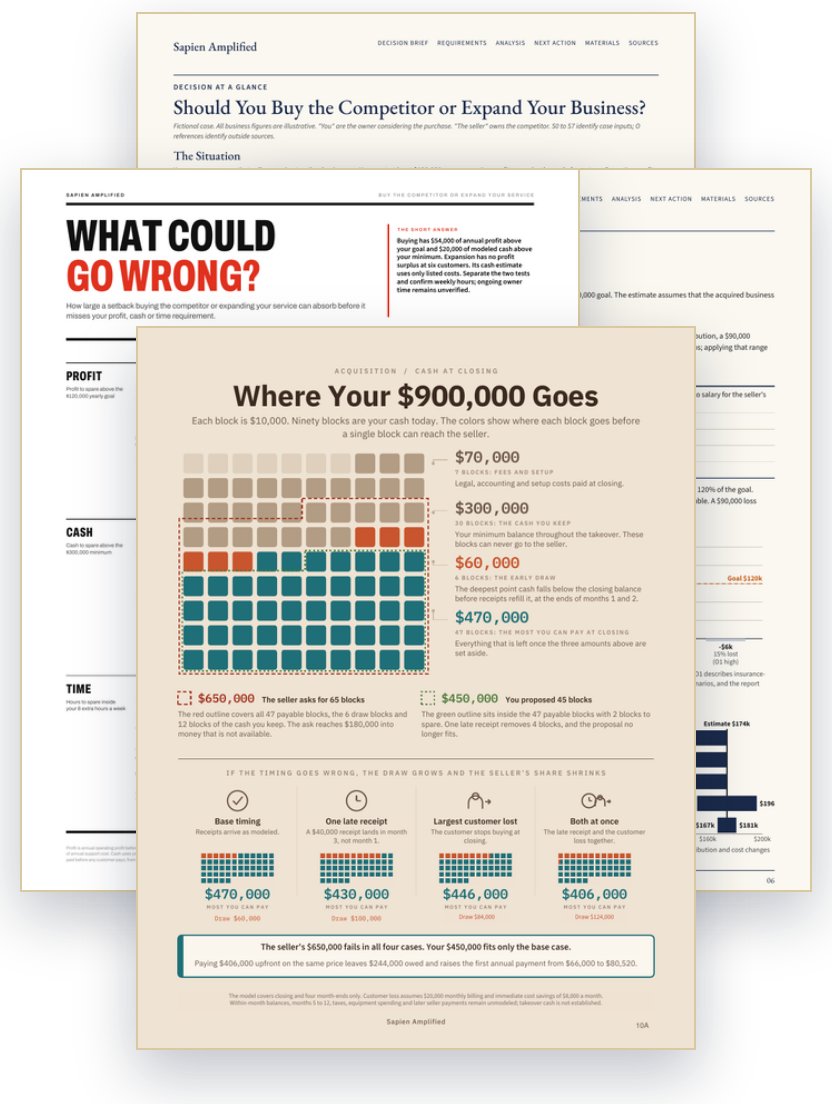
A complete strategic analysis of what to pursue, why it matters, and what success should look like. Test whether your intended course addresses the underlying problem, discover stronger possibilities, and receive a detailed plan shaped around your priorities, resources, and limits.
- Important Findings Reshape What You Should DoThe dossier tests the strongest reasons your preferred course could fail and shows how each important discovery changes your expected results, financial commitments, and next steps.
- Your Decision Is Strengthened Through Independent AI AnalysisA second AI examines the same facts without seeing the first analysis, then both AIs test the work through up to three adversarial waves of challenge, response, and revision, showing what changed and why.
- Every Number Is Traced Back to the SourceEvery figure is tagged to your input or its outside source, with a link and a note on what that source establishes and leaves unanswered.
- Cash and Hours Are Projected Month by MonthMoney and hours are projected period by period, showing when cash would drop below your requirement, when the work would exceed your available hours, and the most you can commit.
- Weaknesses Are Exposed Even When Both AIs AgreeA final review searches the full analysis for unsupported assumptions, overlooked alternatives, and places where the AIs accepted your preferred direction too easily, then carries any changes through.
- Goals Are Tested and Answered SeparatelyEach goal, such as profit, cash, your working hours, and your deadline, is tested and answered separately. The dossier then shows how the results affect one another, including when reaching one goal puts another goal at risk.
- Your Result Is Recalculated for Downside ScenariosCharts show your result at each level of weaker performance, name the one input that moves the result most, and show what happens when two risks arrive together. You see how far results can fall before the plan misses your goal.
- Every Option Is Compared on Cost, Time, and ResultEach competing option receives its own cost, time requirement, expected result, and downside. Every option is measured against the same goals, so the recommendation rests on a like-for-like comparison.
- Unproven Assumptions Are Identified Before You Spend Money or TimeEven when both AIs agree, important assumptions may remain unproven. The dossier names what must be established through records, direct confirmation, or a practical test, and which results would justify proceeding, changing the plan, or stopping.
- Every Conclusion Is Linked to the Full AnalysisThe opening page gives the recommendation, where each goal stands, and the suggested first step. Links take you from each line to the section that holds the full reasoning.
- Letters, Trackers, and Worksheets Are Ready to UseThe dossier includes the questions only you can answer, request letters ready to send, trackers that grade each item you receive, and a worksheet for your decision date. Written rules state when to continue, and a decision record lets you fill in your choice on the page.
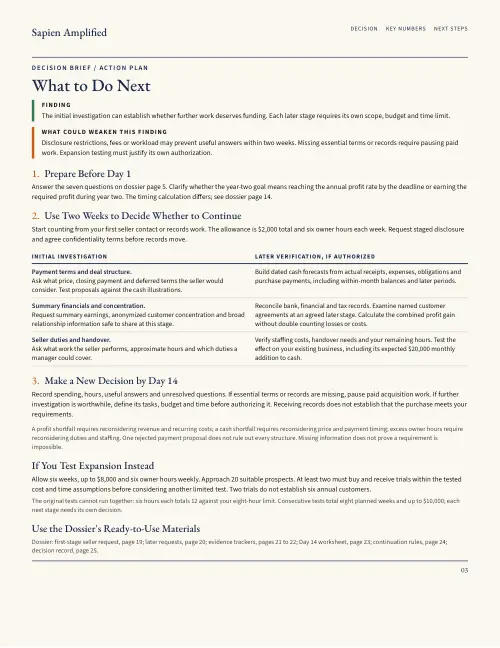
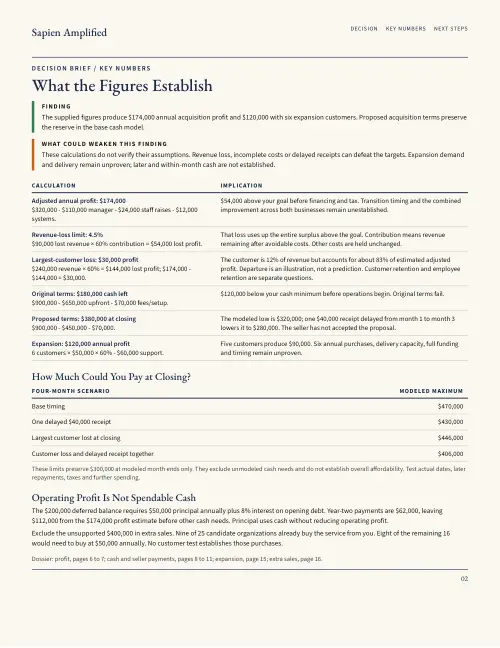
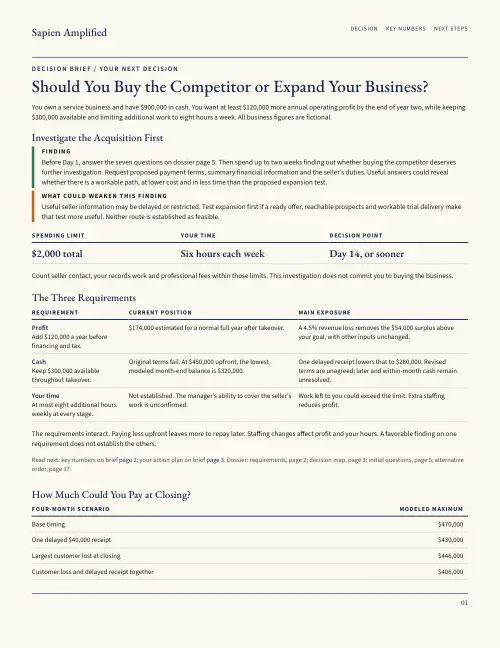
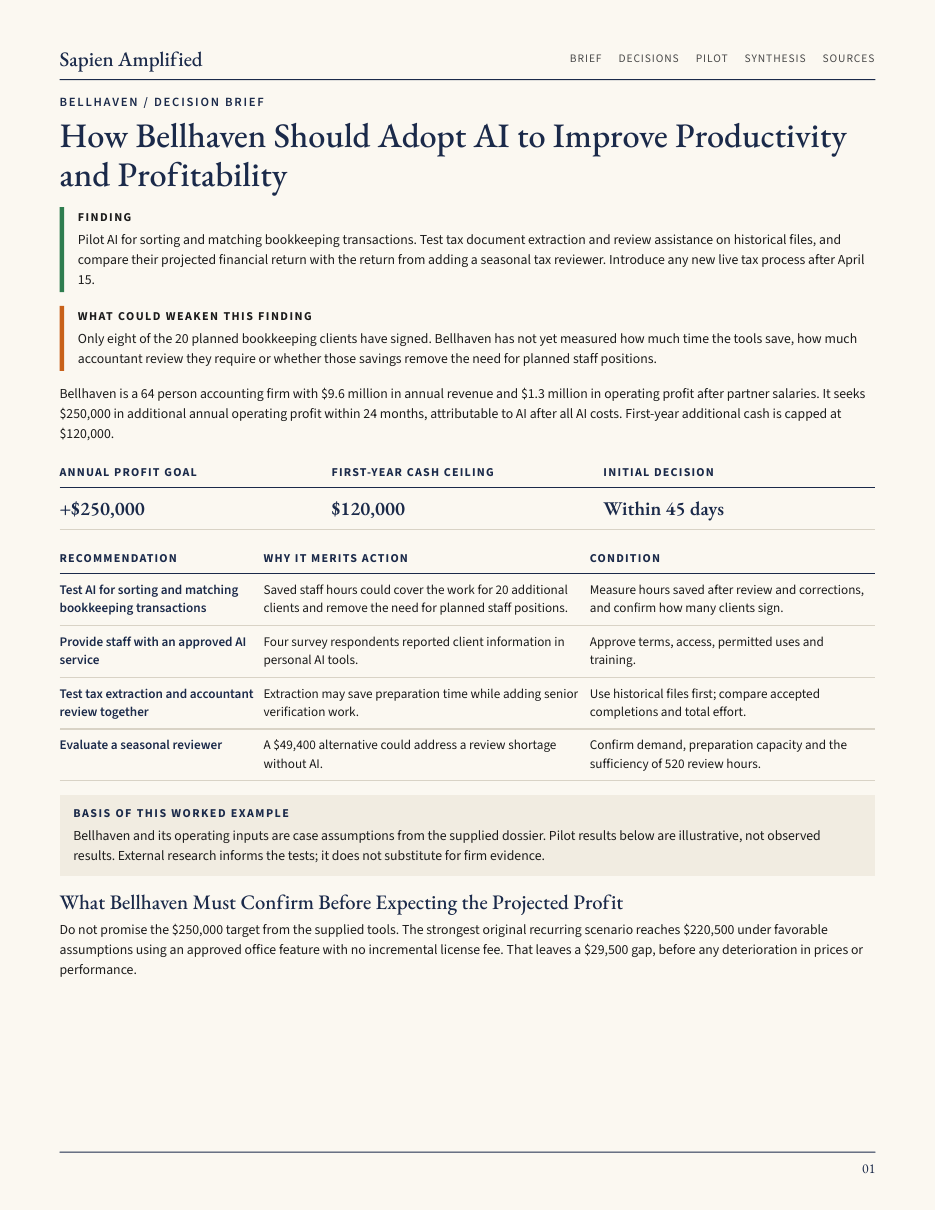
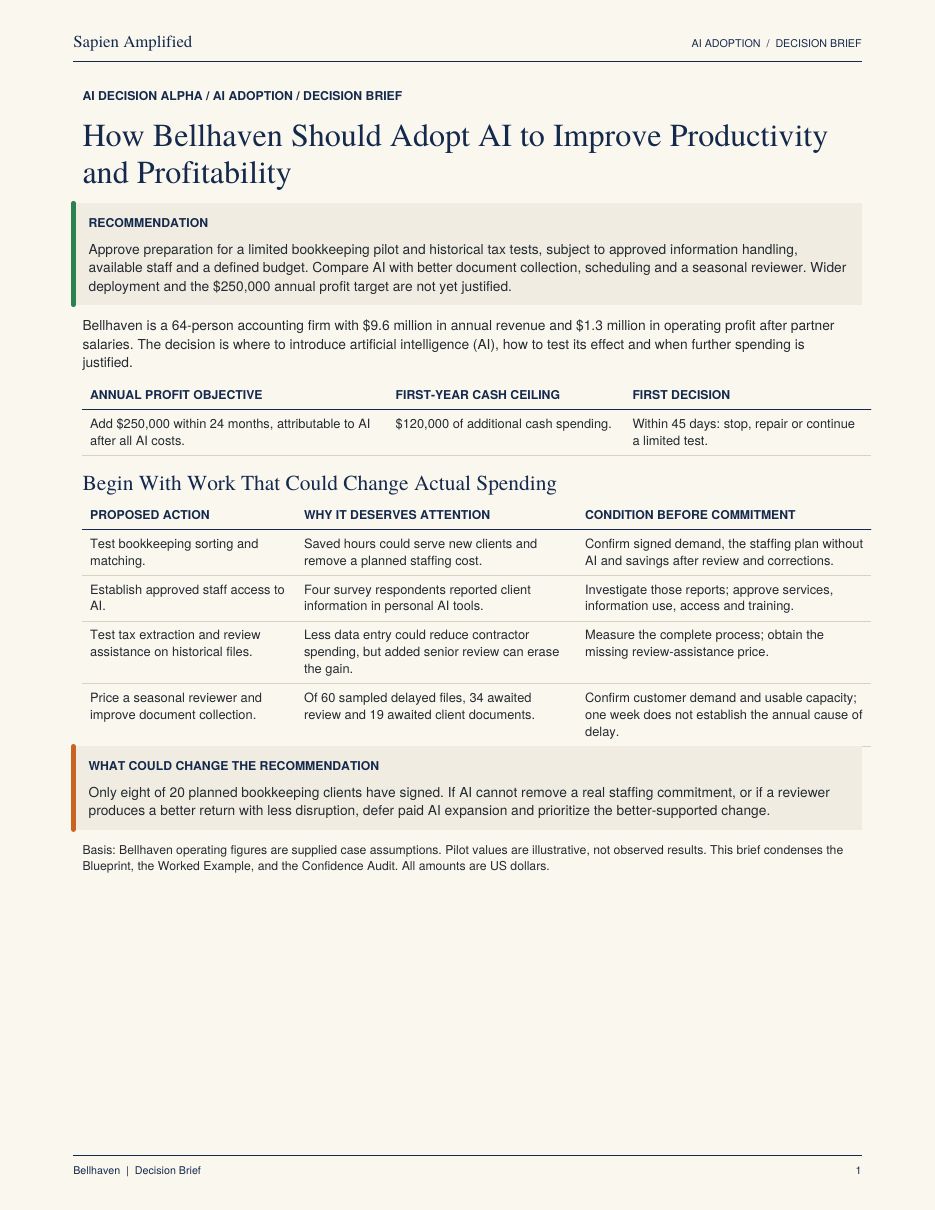
A condensed report for understanding the conclusions and the reasoning without reading the full dossier. The brief brings together the recommendation, main findings, supporting math, largest risks, and next steps.
- Core Recommendations and First Steps Are Stated Clearly Up FrontThe brief opens with the recommendation, the reason for the recommendation, and the first step to take, so the main conclusion reaches you before the supporting detail.
- Every Key Number Is Shown With Its FormulaEach key number appears beside the formula that produced the number and a plain sentence on what the number means, so you can redo the math yourself.
- The Largest Risk to Each Goal Is NamedOne table sets each goal beside where you stand today and the single largest risk to reaching that goal, including details a quick answer passes over.
- Deal-Breakers Are Identified Before You Pay for More WorkThe brief puts the questions that could end the plan first and holds back costly requests until those answers are in, so you avoid paying for work on a plan that will not go ahead.
- The Strongest Alternative Is Compared Side by SideThe strongest alternative receives its own budget, timeline, and success target, so you compare two real options against the same goals and see whether both can run at once.
- Each Step Is Capped in Dollars, Hours, and DaysEach step receives its own spending cap, weekly hours cap, and decision date before work on that step begins. You know the full price of each step before you take that step.
- Unresolved Issues Are Identified Before You Spend Money or TimeThe brief lists material disagreements, assumptions that remain unproven despite AI agreement, and how each could affect your decision, then identifies what would resolve each issue and whether action should wait.
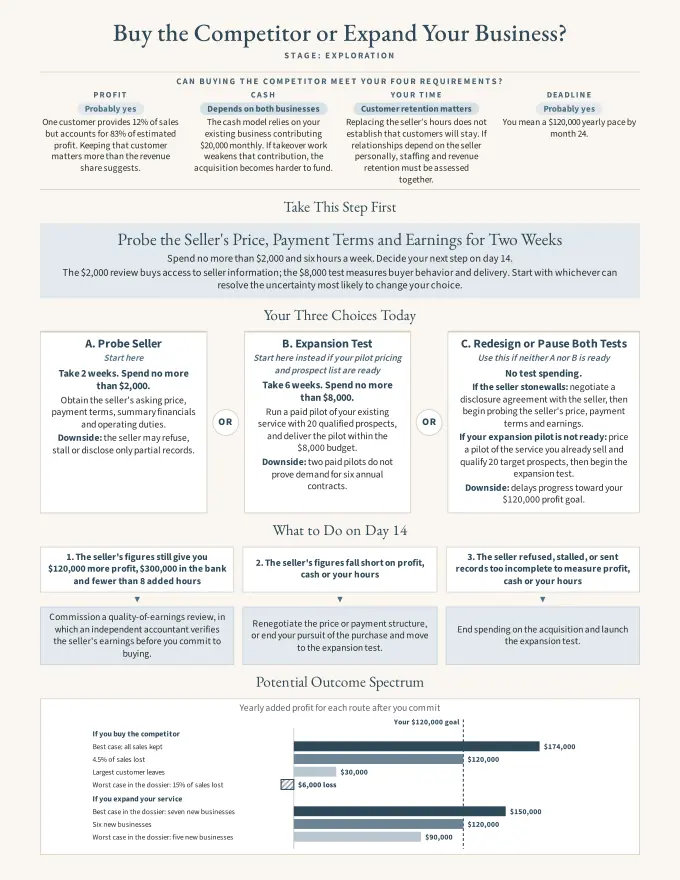
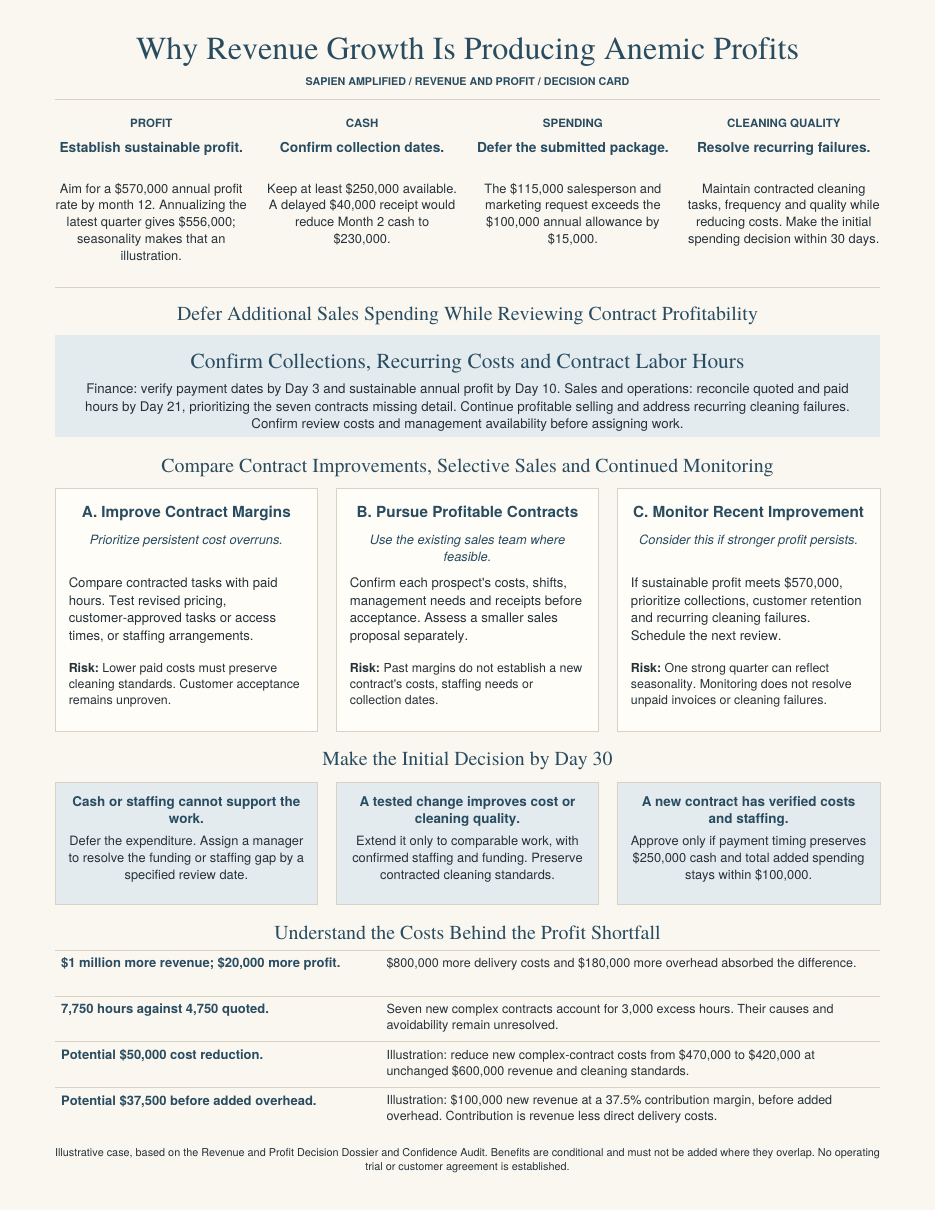
A one-page action guide showing whether each goal is reachable, what to do first, your choices, and how to respond when results arrive.
- Each Goal Is Answered Yes or NoEach goal appears as a plain question with a yes-or-no answer and the single figure that decides the answer, so you see where the plan stands.
- One First Step Is Set With a Budget, Hours, and DateThe card names the first step, the most you will spend, the hours you will give each week, and the day you will decide whether to continue.
- Every Choice Is Shown With What Could Go WrongYour choices appear side by side in the same format, and each one states what you would do and what could go wrong if you pick that choice.
- Results Are Matched to Continue, Renegotiate, Change Course, or StopThe card shows which results justify continuing, which require better terms, and which make another course preferable, with clear thresholds tied to the action you should take.
- The Best and Worst Case Are Charted for Every RouteOne chart plots the best case and the worst case for each route against your goal, so you see how much each route can gain and how much each route can lose.
- The Key Fact to Confirm Before You Spend Money or Time Is NamedThe card names the most important real-world confirmation needed before you spend money or time, the result that means pause or stop, and any unresolved choice requiring your decision.
- The Core Decision Is Presented Visually on One PageYour goals, the first step, your choices, the next move for each result, and the outcome chart appear together on a single page, so you can take in the whole decision at a glance or bring it into a meeting.
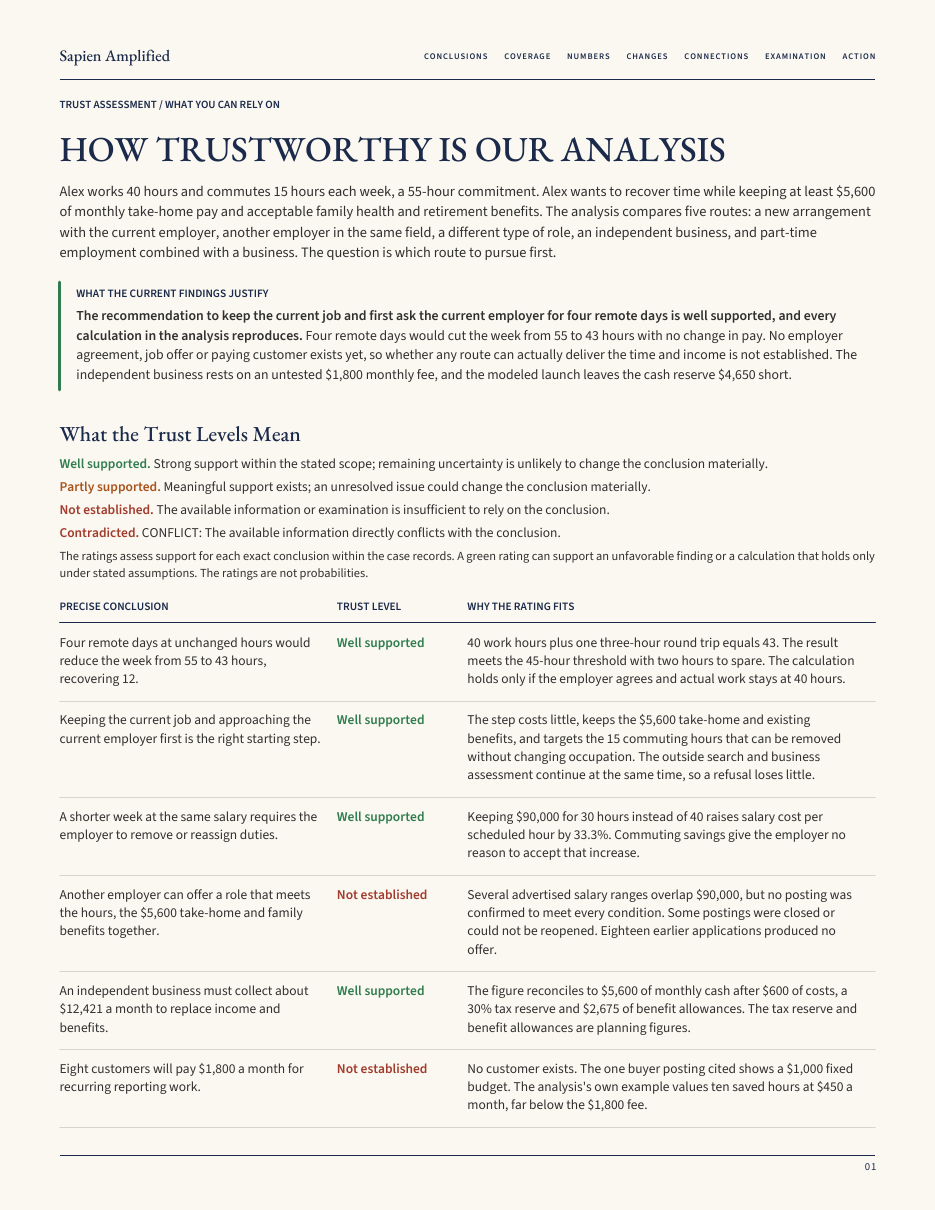
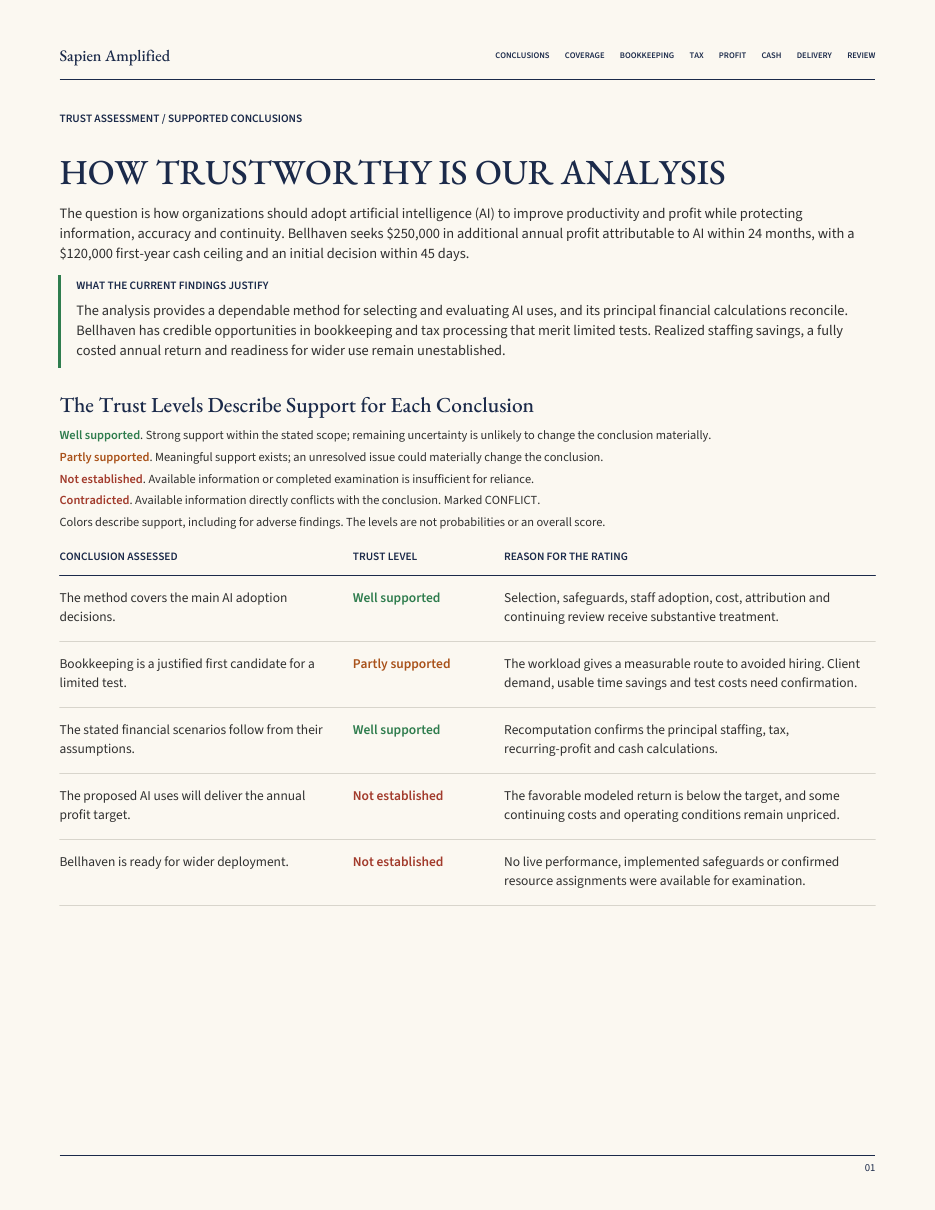
Examines how much you can trust our analysis and its recommendations. It explains which findings are well supported, which depend on assumptions, and what still needs confirmation, so you can act with greater confidence and focus your follow-up on the questions that could change your decision.
Download the Confidence AuditShould you buy another business or expand your existing one? You want $120,000 more annual operating profit by the end of year two, at least $300,000 available throughout the takeover, and no more than eight additional working hours each week. In this example, the following themes from Decision Alpha’s 27 dimensions change what AI examines, what it accepts and what it recommends.
A profitable business can still fail your requirements.
AI tests the purchase against your profit, cash, and time requirements together. The original payment terms leave $180,000 against the $300,000 you require, which is $120,000 below your minimum before operations begin. Your workload remains unconfirmed. The immediate question becomes which route deserves a limited investigation.
An AI suggestion became a $400,000 sales forecast.
AI traces the $400,000 sales forecast to an earlier suggestion that explicitly lacked customer testing. The figure is excluded from operating profit. Repeating the estimate in a forecast does not supply the missing evidence.
One customer accounts for most of the estimated profit.
AI isolates the largest customer’s contribution. If that customer leaves, estimated operating profit falls from $174,000 to $30,000, with other inputs unchanged. That is below your $120,000 goal. Customer departure is a scenario, not a prediction.
Customer loss and late payments can strain cash at the same time.
AI combines the loss of the largest customer with late customer payments into one scenario and measures the cash available at closing under both at once. That combination lowers the most you can pay at closing.
Buying the business must compete with expanding your own.
AI compares a limited acquisition review with an expansion test. It recommends investigating the purchase first, but identifies what could change that order: unavailable records, unworkable terms, or an expansion offer already ready to test.
A separate examination leads to challenges and corrections.
The documented review corrects two interpretations: rejecting one payment proposal does not eliminate every purchase structure, and preliminary seller questions consume your review allowance. Agreement between models still cannot establish whether customers will stay or the seller will accept your terms.
The next commitment is limited before the larger one is considered.
The proposed acquisition review lasts two weeks, costs no more than $2,000 and uses six hours weekly. If essential terms or records remain missing, paid work pauses. Further investigation and any purchase require separate decisions.
Corrections change the plan, and you can see why.
The record preserves the earlier interpretation, the objection, the correction and its practical effect. Seller contact counts from Day 1. Different payment structures require fresh cash calculations. The revised plan retains the reasons behind those changes.
The same question was put to a leading AI model without Decision Alpha's instructions. Each row shows what that out-of-the-box answer missed on one point and what Decision Alpha found on the same point.
| What Decision Alpha did Differently | Out-of-the-box AI answer | Decision Alpha Enhanced Thinking |
|---|---|---|
| TestedYour cash minimum | The out-of-the-box answer described the purchase as workable on its earnings and did not test the payment terms against your $300,000 cash requirement. | Tested the terms against all three requirements and found $180,000 at closing, $120,000 below your minimum. |
| TracedThe $400,000 sales forecast | The out-of-the-box answer acknowledged the extra sales were unproven, yet called that upside the strongest argument for pursuing the purchase. | Traced the $400,000 to an untested AI suggestion and excluded the figure from operating profit. |
| IsolatedThe largest customer | The out-of-the-box answer discussed customer concentration but did not calculate the profit remaining if the largest customer leaves. | Isolated that customer's contribution: profit falls from $174,000 to $30,000 if the customer leaves. |
| CombinedCustomer loss and late payments | The out-of-the-box answer treated the loss of a customer and late customer payments as separate risks. | Combined both risks into one scenario and measured the cash available at closing under both at once. |
| ExpandedGrowing your own business | The out-of-the-box answer addressed only the purchase you asked about and did not price an alternative. | Expanded the question to compare buying with expanding, and named what would reverse the order. |
| ChallengedThe second model's review | The out-of-the-box answer came from one model and was not examined by another. | Challenged the findings with a second model, which corrected two interpretations. |
| CappedThe next step | The out-of-the-box answer recommended further investigation without a spending cap, an hours allowance, or a review deadline. | Capped the review at two weeks, $2,000, and six hours weekly, with rules for pausing. |
| PreservedThe record of corrections | Each revision of the out-of-the-box answer replaced the earlier text, so the reasoning behind the change was not kept. | Preserved the earlier interpretation, the objection, the correction, and the practical effect. |
An answer can acknowledge uncertainty and still give you an incomplete basis for committing money. In the business-purchase comparison, these are the specific gaps and the exposure they could leave you with.
The miss: The ordinary answer describes the purchase as workable on earnings without identifying the failed cash requirement.
The consequence: Original payment terms leave $180,000 against the $300,000 you require, before operations begin. You would start $120,000 below your minimum.
The miss: The ordinary answer discusses customer concentration but does not calculate the profit remaining if the largest customer leaves.
The consequence: Estimated annual operating profit falls from $174,000 to $30,000, with other inputs unchanged. That is below your $120,000 goal. Customer departure is a scenario, not a prediction.
The miss: The ordinary answer acknowledges that the extra sales are unproven, yet calls that upside the strongest argument for pursuing the purchase.
The consequence: $400,000 in unsupported sales could influence how attractive the opportunity looks. The examination traces that figure to an untested AI suggestion and excludes it from operating profit.
The miss: The ordinary answer recommends further investigation without specifying a spending cap, hours allowance or review deadline.
The consequence: You could spend more time and money while essential information remains missing. The defined review limits work to two weeks, $2,000 and six hours weekly, with rules for pausing paid work.
The miss: The ordinary answer treats the two primary risks in this purchase, the loss of the largest customer and late payments from the customers who remain, as separate problems, each of which looks manageable on its own.
The consequence: Losing the largest customer reduces the money coming in, and late payments delay the money that still comes. Combined, those two risks could leave too little cash to operate after closing, even though each risk examined alone suggested the payment was manageable. The analysis sets the most you can pay at closing for that combined scenario.
The ordinary answer recommends investigation, not an immediate purchase. These are possible consequences of acting on incomplete analysis, not observed losses or proof that the business should never be bought.
Before committing to the purchase, you would know how the proposed acquisition measures against your three requirements. Estimated annual operating profit exceeds your $120,000 target with the largest customer retained, but falls from $174,000 to $30,000 if that customer leaves, with other inputs unchanged. The seller’s payment terms leave you $120,000 below your required $300,000 cash reserve. Whether the work fits within eight added hours a week remains unconfirmed. The analysis also examines customer loss and late payments together, showing how both occurring in the same period would further restrict what you could pay at closing.
You would see what supports the earnings and what makes them vulnerable. One customer represents 12% of sales but accounts for approximately 83% of estimated profit. The additional $400,000 sales forecast originated in an earlier AI suggestion that lacked customer testing, so the analysis excludes it from operating profit. Those findings help you judge how much of the acquisition’s appeal rests on existing business, customer retention, and growth that has yet to be established.
Decision Alpha compares purchasing the business with expanding the business you already operate, including a priced expansion test. It also distinguishes rejecting the seller’s original payment proposal from rejecting the acquisition altogether. You could pursue revised purchase terms, investigate expansion, or decline to commit while neither route meets your requirements. The analysis identifies findings that would change which route deserves attention first.
You would enter discussions knowing exactly why the proposed payments breach your cash requirement, how much cash must remain available, and why the amount or timing of payments needs to change. You would also have a profit estimate that excludes the unsupported sales forecast and an expansion alternative against which to assess the seller’s proposal. That gives you specific terms to discuss and reasons for requesting them.
The proposed next step is a two-week review costing no more than $2,000 and taking six hours weekly, with rules for pausing paid work if essential records or terms remain unavailable. Seller contact counts against that allowance from the first day. You would have a defined investigation to complete before deciding whether further expenditure or the acquisition itself is justified.
Each model reviews its own reasoning and challenges the other model’s findings. In this case, the second-model review refined two consequential interpretations: rejecting one payment structure does not eliminate every possible purchase structure, and preliminary seller questions consume the review allowance. You would see the objections and their effect on the plan, alongside matters AI could not establish, including customer retention, seller acceptance of revised terms, and your workload after the purchase.
Decision Alpha organizes the cash examination, forecast scrutiny, customer analysis, expansion comparison, and review of the reasoning into a coordinated process. You still provide information, answer questions, and carry responses between models when using cross-model triangulation. But you have a structure for obtaining and connecting those examinations without having to devise every follow-up request yourself.
The earlier interpretations, objections, revisions, and practical consequences remain available. A partner, lender, or adviser can follow how the analysis developed without asking you to reconstruct the conversation. If the seller changes the terms or new customer information arrives, you can revisit the affected findings and compare the revised plan with the reasons behind the earlier one.
The 32-page Decision Dossier brings together the findings, supporting research, detailed reasoning, conclusions, and action plan. The three-page Decision Brief explains the main findings and next steps with enough context to understand them. The one-page Decision Card shows whether your goals are achievable, the first step to take, your available choices, concrete follow-up actions, and the range of potential outcomes.